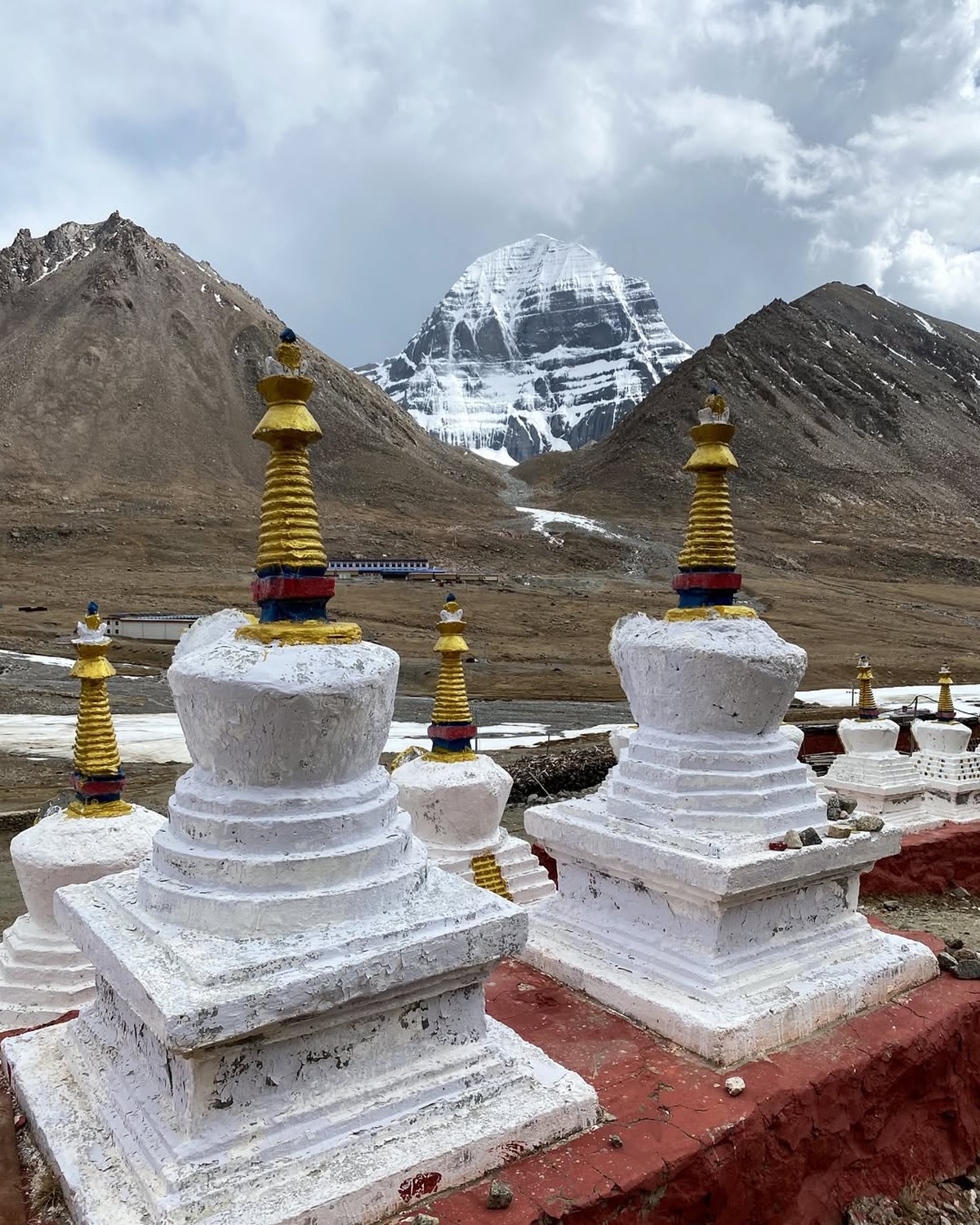
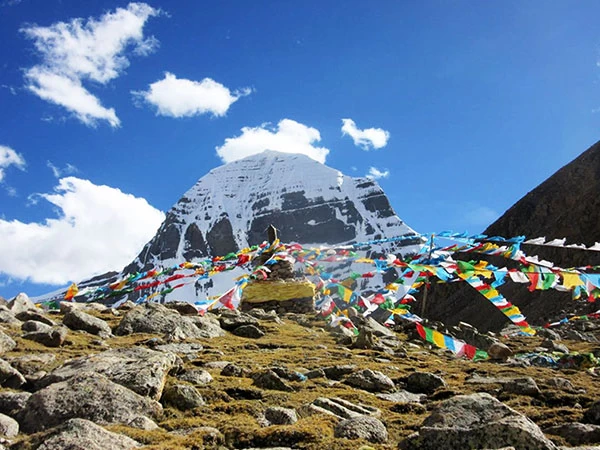
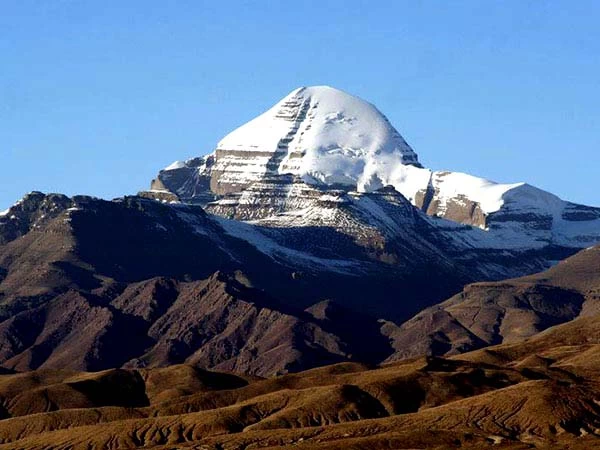
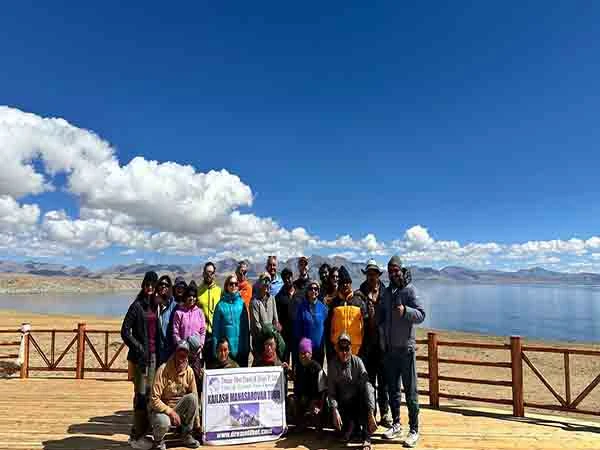
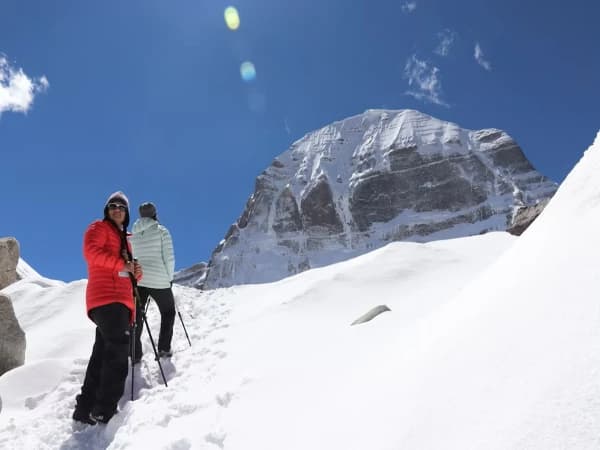
Kailash Mansarovar Ashtapad is reached as part of the sacred Kailash Mansarovar Yatra, typically undertaken overland from Nepal or India and continuing across the border into the Tibetan Autonomous Region of China.
The majority of pilgrims fly to Kathmandu (Nepal) or use Indian entry points, travelling by road to the border crossing at Kerung, entering Tibet and then driving on to Lake Manasarovar and Mount Kailash, where they start their spiritual journey.
From the area near Mount Kailash, pilgrims venturing to the heights aspire for higher altitudes where it has been said that Ashtapad is believed to be located - a high plateau known in Buddhist and Hindu cosmology as a coveted land.
For Jains, Ashtapad is a very holy place for being the mountain where the first Tirthankara, Lord Rishabha, attained Nirvana. Ashtapad literally means “eight steps,” depicting the legendary hill’s breathtaking terrain as well as the spiritual progression towards liberation.
Although there are some classic descriptions of its divine scenery, due to safety and regulatory reasons, access to the physical site has generally been restricted for decades, but the majority of pilgrims make their offerings at several accessible locations close by on the Kailash Mansarovar pilgrimage route.
While getting to Ashtapad is not easy, the Kailash Mansarovar Yatra will be a spiritual journey for many Jains and people of other religions. It provides an opportunity to explore the rugged and majestic Himalayan plateau while performing rituals, prayers, and reflections that create a greater sense of connection to the holy sites. This guide provides an overview of routes, travel arrangements, required permits and practices, as well as valuable information about your spiritual journey.
How to Reach Kailash Mansarovar Ashtapad?
Caption
In order to get to Kailash Mansarovar Ashtapad, pilgrims first need to reach the region of Kailash and Mansarovar in Tibet, as this place is located in the upper Himalayan ranges, closer to Mount Kailash and can not be accessed individually.
The travel is conducted through approved pilgrimage routes, preferably Nepal (Kathmandu route) and on an occasional basis via India – Lipulekh route, depending on the permissions obtained for a particular year in terms of season.
The most common, and the current easiest way that Jains walk through is the Kathmandu to Kerung to Saga to Darchen route.
From Kathmandu, the journey crosses into Tibet via the Kerung (Gyirong) border crossing before driving overland towards Saga and Darchen and the Mount Kailash region.
Ashtapad itself is a prohibited and sacred place; There is no direct physical access allowed for safety in this remote set of peaks. However devotees go nearest point of Kailash, known as Chhada darshan, during their pilgrimage to Kailash Mansarovar.
Where is Ashtapad Jain Tirth?
Ashtapad Jain Tirt is believed to be the mountain in the snow-clad Himalayas near Mount Kailash and Lake Mansarovar (in Tibet, China). Ashtapad means "8 steps" of Nirvana. It is revered in Jainism as the place where Lord Rishabhdev (Adinath), the first Tirthankar, attained Nirvana (salvation).
Traditional Location and Features
Location: Western Tibet AR, County of Purang (Prefecture Ngari), China
Near: Kailash Mountain (Kang Rinpoche) and Lake Mansarovar
Elevation: Often described around 4,900–6,000 m (16,000–19,685 ft) depending on interpretation of sources
Coordinates
Coordinate details about ancient Ashtapad are not available on modern maps, but it is widely recognized and revered in the texts of Hinduism to be around Mount Kailash:
Place
Latitude
Longitude
Mount Kailash (reference point)
31.0675° N
81.3126° E
Lake Mansarovar
30.8840° N
81.3137° E
Approx. Ashtapad vicinity
31.05° N
81.40° E
The exact location of the old Ashtapad Jain Tirth is not known, and it has become a matter of spiritual belief and scholarly research. The site is included in several traditional Jain texts among the high peaks of the Himalayas (a close position to Kailash), but none of them provides a specific GPS location.
No one knows precisely where Ashtapad Jain Tirth is: some scholars consider it lost, or allegorical, not situated on maps. The ancient Jain scriptures Tirthankar Vihar are located north of Badrinath, about 5-7 miles from Lake Mansarovar and in close vicinity of Mount Kailash, but no firm GPS evidence is available.
Is Ashtapad Open for Pilgrims and Travelers in 2026?
In 2026, access to Ashtapad continues to be restricted in accordance with the People's Republic of China (Tibet Autonomous Region) policies governing the Mount Kailash - Mansarovar pilgrimage area. The Chinese government has resumed the Kailash Mansarovar Yatra after a five-year discontinuation due to the COVID-19 pandemic, but has not allowed independent access specifically to Ashtapad. Ashtapad is located in a high-altitude, sensitive border and restricted zone near Mount Kailash; consequently, pilgrims have to view or honour Ashtapad from designated locations along their journey on the broader Kailash Mansarovar pilgrimage route.
There are no separate public permissions granted for access to Ashtapad itself; as such, all pilgrims to Kailash Mansarovar must participate as part of an approved Kailash Mansarovar Yatra package and possess both valid group visas for China and Tibet Travel Permits. Other than through participation in an approved Kailash Mansarovar Yatra package, no legal means of accessing Ashtapad exist by means of current governmental policies.
The Kailash Mansarovar Pilgrimage Season takes place from April to September each year. Pilgrims can apply for permits allowing them entry into the region of Western Tibet through an entry point (Border) that is agreed upon through Diplomacy between China and Nepal (e.g., Kerung, Rasuwa, other designated areas).
Access Aspect
Status / Official Detail
Ashtapad direct access
Not open, No independent permit; only symbolic/distant view as part of Kailash Yatra
Kailash Mansarovar Yatra
Resumed mid-2025 after five years, with permits issued
Indian pilgrims access
Allowed via Nepal routes (e.g., Rasuwa-Kerung) under group permits
Permit requirement
Chinese Group Visa + Tibet Travel Permit (TTP) mandatory
Seasonal access period
April–September typical pilgrimage window
Option 1 to Reach Ashtapad: How to Reach Kailash Mansarovar Ashtapad from India?
Jain pilgrimages from India to Kailash Mansarovar and the Ashtapad site are organized and managed by the Indian government through the Ministry of External Affairs (MEA). Pilgrims register for the journey at New Delhi and travel either by plane, bus or train to the Lipulekh Pass (Uttarakhand) or the Nathu La Pass (Sikkim). Once at the Pass, each pilgrim travels overland into Tibet, then by road to Lake Mansarovar and Darchen, where they will begin the holy three-day circumambulation of Mount Kailash (Kailash Parikrama).
Once the circumambulation is complete, there is an additional 7 to 9-hour round-trip trek from Darchen to the Ashtapad site (4,900 meters), which is considered holy because of the association with the nirvana of Lord Rishabhdev. To ensure that there is a special inner-zone guide to accompany the trek to Ashtapad, pilgrims are required to inform the MEA liaison officer or their respective group leader a minimum of two days before departing Darchen.
Around 750 to 1,000 Jain and Hindu pilgrims each year are selected by the MEA from over 6,000 applicants for this pilgrimage via lottery. The voyage via the Lipulekh Pass is designed to be more challenging but usually attracts younger and fitter individuals and lasts for approximately 22 to 25 days. The alternative is slightly less complex and will take about 18–22 days to cross to Nathu La. It has better access for vehicles, so it would be more convenient for the elderly and women with health problems.
Route
Duration
Difficulty
Batches/Spots
Best For
Lipulekh Pass
22 days
High (90km trek)
5 batches/250
Fit trekkers
Nathu La Pass
21 days
Moderate (drives)
10 batches/500
Seniors/drivers
Ashtapad Add-On
+1 day
High (4,900m trek)
Permission-based
Jains post-kora
Lipulekh Pass Route: Step-by-Step
Dharchula to Gunji Base Camp
Jain-yatris assemble at Dharchula (915m, Pithoragarh district) with a valid passport and, selection letter from MEA. They take common jeeps and drive 50 km up to Gunji (3,200m) through the gorges of the Kali River. Pilgrims sing the Navkar Mantra to protect themselves in avalanche-prone stretches. Night stays with dal-bhati vegetarian meals are available at ITBP camps. The Pilgrims acclimatize and to cope with minimal AMS headaches by adopting ancient spiritual practices.
Gunji to Nabhidang and Lipulekh Crossing
For 20km, pilgrims walk or ride ponies uphill to Nabhidang (4,300m) on rocky moraine paths. They all have sturdy high-ankle boots and a portable jal pack combined with a moong dal pouch. Pilgrims chant Rishabhdev nirvana slokas to gain strength. The last 10km to Lipulekh Pass (5,334m) can take 4–6hr on snow and ice. Chinese officials imprint TTP on the tri-junction camp. Yaks carry equipment as pilgrims glimpse Mount Kailash and experience devotion for Ashtapad’s eight summits.
Lipulekh to Taklakot (Purang)
Pilgrims descent by bus for 30 km to Taklakot (3,800m) across dusty plateaus with nomad tents. The ride takes 4–5 hours. Basic guesthouses offer rest. The evening Ashtapad arti will be performed by the pilgrims with personal diya lamps to purify the soul before moving into higher planes.
Taklakot to Lake Mansarovar (Chiu Gompa)
Another 2-hour drive in a coach takes us to the source of the Sutlej at Mansarovar (4,560m). Fitter Jains do one parikrama of the entire mount, chanting “Namo Arihantananam” In respect of the Tirthankaras. They bathe at dawn as the karmic impurities melt away from them like ropes from Rishabhdev.
Mansarovar to Darchen
Pilgrims are driven 1 hour to Darchen (4,664m). The sight of the Yama Dwar darshan evokes enthusiasm for parikrama. They bring along oxygen cans and thermals for Ashtapad’s altitudes.
Darchen to Ashtapad Trek
Pilgrims rest and leave at dawn after parikrama. A jeep ride of 30 minutes takes you to Serlung Gompa (4,200m). They walk 3km at 35 degrees uphill to climb 700 metres on loose scree that requires the endurance of Rishabhdev’s penance. Ashtapad amphitheater (4,900m): 3 hours. Pilgrims visit Ashtapad. 1 to 2 hours of silent meditation in front of Kailash, visualising the jeweled temple of King Bharat. It takes 2-3 hours to descend with bhajans of thanks for the moksha darshan.
This route requires top fitness. Pilgrims train on Annapurna Base Camp treks. Cardiac pilgrims obtain medical clearance. Then it’s a 5,300m trek over the Dolma La to prepare the lungs for Ashtapad’s rarefied air, where divine visions occur.
Nathu La Pass Route
Gangtok to Nathu La Border
Jain pilgrims fly from Mumbai to Bagdogra and drive to Gangtok (1,650m) with restricted area permits. They then travel 52km along the Silk Route to Nathu La (4,310m). Monsoon landslides are a risk, and so pilgrims chant pachchakkhan sutras amid prayer flags.
Nathu La Crossing to Chungthang Camp
Pilgrims trek 5km over the pass to Tibet. They are driven by bus up to their base camp in Chungthang (4,000m). ITBP escorts provide vegetarian thalis. Evening talks to develop sangha spirit, Groupsangha spirit, building the significance of Ashtapad's Trisasti-Salakapurusa.
Chungthang to Taklakot
Pilgrims make a 100-km journey via the western plateaus for 3-4 hours with glimpses of Everest. They stop at AMS checkpoints, a necessity for the elderly who refer to Rishabhdev's long life post kevalgyan.
Taklakot to Mansarovar and Darchen
Pilgrims drive for two hours along the Sutlej valley to Chiu Gompa, for Mansarovar snan — a bath at the site that is said to wash away lifetimes' worth of karma. They rush to Darchen anyhow for parikrama preparation with focused upvas at Ashtapad.
Darchen to Ashtapad Extension
Pilgrims take the Serlung trail for an early climb, avoiding wind blasts and rocky gullies. These obstacles are the proving grounds, like the illusion of life's maya. And they stop halfway up for a logassa sutra recitation. Darshan of panoramic Kailasha at the summit will unleash the nirvana energies. Pilgrims do the symbolic chaityavandan without idols.
Nathu La provides a gentler acclimatization for the over-50 Jains. Ponies help legs less intense, but the last pitch of Ashtapad is foot penance.
Option 2 to Reach Kailash Ashtapad: Kailash Mansarovar Ashtapad Route via Nepal
Nepal's Kathmandu route is the preferred and most flexible means for Indian Jain pilgrims in search of Ashtapad, avoiding government lotteries through private operators who obtain Chinese Group Visas and Tibet Travel Permits (TTP) directly. It provides uninterrupted Ashtapad extensions post Kailash parikrama with their own stotra recitals and rituals at the 4,900m nirvana viewpoint.
Step-by-Step Route from Kathmandu to Ashtapad
Visa and Preparations in Kathmandu
The Jain Pilgrims arrive at Tribhuvan, their international airport, where they will apply for a travel visa upon arrival and receive a Chinese Group Visa through an agency in Lhasa. When they arrive in Thamel, they will be checked for their TTP paper, and their pulse oximeter reading should be over 90%. They are to prepare for their Jain puja using the items in their Diamox pack (medication), Rudraksha mala and Ashtapad stotram books. Evening bhajans (devotional music) help prepare for their journey to nirvana.
Travel from Kathmandu to Syabrubesi
The Jain Pilgrims depart from Kathmandu early on the morning of their first day of their 115km (70-mile) trip down the Araniko Highway. Their five to six-hour drive will take them through the Bhote Koshi gorges with views of the Langtang range. Once they arrive at Betrawati, they will find that the highway has been paved from the airport to Betrawati, but there will be several gravel portions of the road along the way. The altitude will rise gradually during this trip, from approximately 1400m (approx 4591ft) to 2380m (approx 7807ft). Once they reach Timure, they will have lunch where they can enjoy vegetarian momos (dumplings) containing only onion for those adhering to the ahimsa (non-violent) ideas.
Syabrubesi to Kerung Border
Drive 20km on mixing off-road (1 hour) to Rasuwagadhi (1,900m). There, they receive Nepal exit stamps. Gyantse pilgrims cross a 500m suspension bridge with prayer wheels. A Chinese shuttle bus to Kerung (2,700m) is possible in 30 minutes.
Kerung Entry Formalities
Chinese officials examine TTP visas and passports. (They screen baggage by X-ray, no meat or electronics that weigh more than 5 kilograms.) The group sleeps in the guesthouses of Kerung and offers border prayers towards Kailash.
Kerung to Taklakot (Purang) Plateau Drive
Pilgrims travel along a dusty highway for 260km/8‑10 hours through the dry valleys. They pause for photos at Peiku Lake. The potholed road is passable in 4x4 vehicles. They head into Ngari Prefecture, where nomad tents mark that Kailash is close.
Taklakot to Chiu Gompa (Mansarovar)
The team covers 50km of good tarmac for a couple of hours alongside the beginning of the Sutlej River. They arrive at sacred Lake Mansarovar, 4,560m Pilgrims bathe at sunrise to cleanse bad karma. They kindle a homa fire with ghee for prayers to make it to moksha.
Mansarovar to Darchen
Pilgrims take a 1-hour, 40km drive on a paved road to Darchen Base Camp at an altitude of 4,664m. They bow at the Yama Dwar gate to begin the parikrama walk. Ashtapad homes: They refill oxygen for Ashtapad’s frigid air.
Darchen to Ashtapad Trek
A jeep ride takes them 5km to the Serlung Gompa trailhead. There is 600m of ascent on the three-hour climb to the top, and the loose scree and steep slopes of around 35° make for a lot of effort. It tries the long haul in ways mimicking spiritual practice. They remain for 2 hours in darshan at the eight-peaked ridge meditating on Rishabhdev's nirvan. It is followed by victory bhajans, which are danced and sung after the 2.5-hour descent.
Kathmandu to Kerung Border- First Entry Point to Tibet
Kathmandu's Ring Road lies roughly 135 km from the Rasuwagadhi-Kerung border survey spot. It takes about six and a half hours to drive up to an altitude of 1300 metres. The route is a combination of a fast Motorway and bumpy mountain roads. With recent road improvements, most of the roadbed has now been laid with asphalt, which is a substantial improvement over the old dirt and gravel.
Road Conditions Overview
The journey begins on a four-lane expressway to Bhaktapur before dipping onto the two-lane Araniko Highway. The pavement is still smooth. There are plenty of fill-ups every 30 k or so. Big trucks and zippy buses will often overtake you on blind curvy sections of the road, but that doesn't mean you shouldn't drive safely.
Kodari to Syabrubesi ( around 35 km).
Kodari to Syabrubesi ( around 35 km). This section narrows to a single lane hugging the mountainside, a steep fall away from hundreds of feet plunging to the Bhote Koshi River. Loose scree and small rockslides are even more frequent in July and August.
The last part (around 10 km) from Syabrubesi to Rasuwagadhi border is an unpaved road in bad condition due to the Monsoon rains, which have caused many potholes. Although there are steep sections (up to 20% gradient), they can be traversed by high clearance vehicles.
Currently, there are ongoing bridge replacement projects expected to be finished by 2026, providing continuous access to the border throughout the year.
Travel Time and Border Procedures
Kathmandu to the border takes approximately 6.5 hours on average. It is wise for travellers to allow themselves up to 9 hours for potential delays, meals and short breaks. The majority of groups will eat lunch consisting of a simple vegetarian dal bhat meal. Many also stop at the Nagthali Ghyang Viewing Point, where one can catch the first glimpse of the Tibetan Plateau.
At the Rasuwagadhi border post, customs hours of operation are between 8:00 AM and 5:00 PM. Nepal Customs permits religious items used for puja (worship) without any customs duty. On the Chinese (Tibetan) side, China requires that anyone crossing the border must enter as part of a group (with a minimum-sized group). Permits and arrangements for yaks and porters to transport luggage are organised through approved TTP agents. This location gives you your first real experience of Tibetan culture - see monks, prayer flags and monasteries in proximity to the border crossing.
Kerung to Saga and Darchen Travel Details One Must Know
Hire jeeps that are used by the pilgrims to travel only half of the distance (720 kilometres) to Kerung – Saga – Darchen by buses, since they arrive in batches through hired buses of 40-60 in number. The route crosses four high mountain passes and has Acclimatization rest days before reaching the base camp of the Ashtapad trek.
Kerung to Nyalam
Travel starts around 8 AM. The 35 km route takes about one hour on a gravel road that reaches Nyalam at 3,750 m.
The pass is traversed at 5,100 metres, which cuts into tight bends and loose gravel that reduces vehicle speeds.
Accommodations are simple raised concrete dorms with shared toilets and boiled water. Potato-based staple like dal and roti helps with acclimatization to altitude.
Nyalam to Saga
The road journey from Gyal to Saga (341 km) [app 10 hours] is across Lalung La Pass 5,050 m; frequent halts are made due to strong winds, dust and potholes. Saga is 4,600 meters and an important point for acclimatization. Travelers sleep two nights in bare-bones rooms with metal beds and bucket baths, with time to rest and stabilize oxygen levels.
Saga to Paryang
It is a 270-kilometre journey taking around 7 hours, over a very flat plateau. Tea stops are at Zhongba. Nomad herds and sandy sections impede progress. Paryang provides basic rooms with solar lighting and shared bathrooms.
Paryang to Darchen
The last 75 km pass in about two hours on better roads to Darchen (4,664 m) with simple lodges for overnight stay before proceeding along the Ashtapad route.
They spend 2 days in Saga and Paryang; bring their own personal Diamox as well as ginger; and take it easy to deal with the altitude properly.
How to Reach Ashtapad from the Mount Kailash Area?
Jain pilgrims visiting Ashtapad from the Mount Kailash area embark on a special out-route trek originating at Darchen. Travel can be done only in escorted groups, generally of not more than a dozen people at most, and travel alone is prohibited.
Special Route via Serlung Gompa
The access trek starts with a 5 km drive or walk from Darchen to Serlung Gompa, around 4,200 meters. There is no public transport serving this route, and military checkpoints regulate access. From Serlung pilgrims follow a thin cairn-marked trail leading north-west towards the south-west face of Mount Kailash. The trail remains distinct from the outer kora and must not be mistaken for a trek route or walked on by those with special permission. Clearance is arranged with officials by the local Tibetan guides before departure .
Permit and Travel Rules
Pilgrims are required to apply at the route in the Darchen PSB office at least 48 hours ahead of time. Each group is guided by a local licensed guide who possesses communication devices. Travel is permitted only in daylight, and camping on the ridge is illegal. No pack animals are allowed beyond Serlung, so the trek continues on foot.
Restrictions and Safety Rules
Only physically fit pilgrims with normal oxygen levels has access. The roads are seasonally closed in the heavy monsoon and winter months. The use of drones, professional cameras and off-route movement is still not allowed. From Serlung, there are no further mobile signals, and you can only be evacuated from Darchen if the need arises.
How to Complete The Ashtapad Trek for Jain Pilgrims?
Pilgrims trek 3km from Serlung Gompa to the unmarked Ashtapad ridge. The path, in three stages, ascends steadily, at grades of 30–40° over scree and narrow gullies. The first kilometer is a gradual climb, about 200 meters ascent in 45 minutes, which allows for warm-up and occasional prayer stops.
The second of the three kilometers steepens, with hand-over-rock ascents. It was hard to breathe with wind gusts here, at 4,600 meters. Trekking poles assist in balancing on loose stone. The final kilometer climbs switchbacks across scree, with potential early June snow fields to the ridge crest at 4,900m in 2.5–3 hours up and down.
The ridge opens onto a flat, heart-shaped plateau surrounded by eight sharply pointed mountains around Mount Kailash. Most pilgrims just spend an hour or two here doing pranam, that’s walking clockwise around the natural stone formations reciting prayers, or not saying a word.
There’s nothing up here, no tea shop, no shelter. Carry at least one liter of water a person and wear a windproof layer; it’s cold and windy even on clear days.
2 to 2.5 hours descent. Trekking poles can help if you have them, it gets loose and steep in places, and slipping happens. Go slow.
It’ll be early afternoon when you reach Serlung. Get tea there if you want, and then take a jeep back to Darchen. Most groups get to the lodges around 4pm.
Alternative Routes Section For Reaching Ashtapad Kailash Mansarovar
Kailash Mansarovar Ashtapad via Lhasa
Pilgrims can reach Kailash Mansarovar and Ashtapad via Lhasa — Tibet’s capital — instead of the usual Nepal or Indian border passes. Travelers typically fly or take a train to Lhasa, the gateway to the Tibetan plateau and its culture.
Lahksa, following it is gradually moving to other ground means (bus or a connecting flight) to Ngari Gunsa Airport, which is the nearest airport to Mount Kailash and Lake Mansarovar. Slip westward to the sacred places on highways, cutting a relaxed route across the plateau.
The journey gives pilgrims the opportunity to visit world-heritage sites like Lhasa’s Potala Palace and Jokhang Temple while acclimating slowly to extreme altitude before undertaking the trek. This is usually arranged by tourists through authorized travel agents, because all foreign visitors to Tibet must have a Tibet Travel Permit and other necessary permits for trekking in the restricted areas of Mt.Kailash and Ashtapad.
Traveling to Ashtapad Through the Lhasa Air and Road Route
Lhasa air plus road route. Foreign pilgrims arrive directly at Lhasa Gonggar Airport from main Asian cities. A flight from Lhasa to Ngari Gunsa Airport, the nearest airport to both Mount Kailash and Lake Mansarovar in Tibet, shrinks travel time considerably.
Lhasa to Gunsa by air will take about 2 hours, and the distance is approximate 1100-1265 km. Pilgrims drive from Gunsa around 200 km (3-4 hours) to Darchen, the base town for the Kailash Mansarovar circuit. At Darchen, visitors rest and acclimate, perhaps making a ritual circuit of the sacred Manasarovar Lake in preparation for gazing from yet authorized overlooks at Ashtapad.
This route is ideal for those who are short of time and don't want to travel the more extended multi-day journey overland from Lhasa. All tourists are required to apply for entrance permits, like the Tibet Travel Permit and restricted-area pass, organized by certified travel agencies.
Overland Travel from Lhasa to the Kailash Region
For centuries, pilgrims have been taking the overland route to Kailash Mansarovar from Lhasa! From Lhasa (3,650m), pilgrims journey on the Friendship Highway (G318) as well as other roads in Tibet and onto higher ground to remote settlements and pilgrimage sites.
Main Overland Routes
South route: Lhasa → Gyantse → Shigatse → Tingri → Everest Base Area(Old Dingri)→ Saga → Lake Mansarovar Region → Darchen. Distance: 1,600–1,700km. Itinerary Duration: 4-6 days, including rest and acclimatization days.
Northern Route: Lhasa→ Namtso Lake→ Baingoin→ Nyima→ countryside, Nagqu→ Darchen. Distance: 1,830km. This longer, rougher path offers rockier surfaces and a bit more adventure.
Both require organized logistics, permits and good guides due to the altitude and isolation. On the way, there are vast grasslands, sacred lakes, Tibetan villages and high mountain passes, as well as nomad tents. The path itself, in the spiritual and philosophical senses, is also an integral part of Kailash yatras rather than a passage to Darchen.
Who is Eligible to Visit Kailash Mansarovar Ashtapad?
Pilgrims of All Faiths
The pilgrimage is for Hindus, Buddhists, Jains and Bonpos followers. Religious is not the law; eligibility is based on permits and marital health.
Foreign Nationals
Non-Chinese travelers are required to participate in a registered tour group organized by a travel agency that is authorized by the TAR. Independent travel is not allowed.
Indian Citizens
Indian pilgrims require a valid passport, a Chinese group visa and a Tibet Travel Permit (TTP). Voter ID, etc, are not accepted for the Tibet part.
Health and Age Requirements
Travellers must be medically fit to travel at high altitudes, usually over 4,500m, whereas the Tibetan authorities generally do not issue permits to those older than 70 unless provided with a certificate from doctors that confirms their fitness. Good acclimation and planning are required for tubers to join in safely.
Significance of Ashtapad Jain Temple
According to Jain tradition, Ashtapad is an important part of Jain beliefs. This is the place where Lord Rishabhdev (Adinath), the first Jain Tirthankara (Liberator), became liberated (i.e., attained nirvana). According to Jain texts, he attained moksha (final liberation) while on Ashtapad.
The word Ashtapad means “eight steps.” The eight steps in Ashtapad represent the journey one must go through to reach the highest spiritual state of moksha (which is connected to Rishabhdev).
The tradition of Jain scriptures shows that Rishabhdev's son, King Bharat, the Chakravarti King, created a memorial to his father's attainment of enlightenment by constructing a palace made from the most valuable gemstones.
Because the exact physical location of the mountain, Ashtapad, is challenging to reach and has been debated over the years, many Jain followers across India create temple models and art to pay tribute to it. These symbolic representations and models serve as places of worship and as a reminder of the spiritual journey one takes in order to reach liberation.
In addition to its mythology, Ashtapad represents core values of Jainism: non‑violence, self-discipline, renunciation and truth. Even with limited access to the location, Ashtapad continues to inspire millions of pilgrims around the world as a significant representation of the spiritual journey to achieve enlightenment and ultimately liberation from suffering.
Is Ashtapad Darshan Allowed? (Traveling from Nepal)
Yes, but with important restrictions. Pilgrims cannot visit Ashtapad directly. Chinese and Tibetan authorities restrict independent access for safety and regulatory reasons.
Travelers cannot make a special visit to see Ashtapad, as it falls on the way of Kangchenjunga. But others participating in the official Kailash Mansarovar Yatra from Nepal can also experience the spiritual significance of Ashtapad.
Although the physical location is not accessible, authorized pilgrims can see or pay homage from prescribed viewing areas in other regions of Kailash Mansarovar such as near Lake Manasarovar and Darchen. The pilgrims may also offer rituals and prayers to merge into the divine environment in Ashtapad.
What Is Ashtapad in History?
Ashtapad is a very sacred place in Jain terms. It is this place where lord Rishabhdev, the first Tirthankara, accomplished Nirvana after a period of steadfast meditation under the shade here.
Meaning of the Name “Ashtapad”
Ashtapad is a combination of two Sanskrit words, which mean “eight steps/bases/feet” and/or “eight portions”. These peaks meet to form a throne of a summit where the divine occurs. In Jain texts, the eight hill ranges are said to represent the stairs of moksha, and each range corresponds to a specific stage in spiritual ascent between karmic bondage bind towards liberation or kevalgyana.
Ashtapad as a Major Jain Maha Tirth
Ashtapad As a Principal Jain Maha Tirth (Maha means great or supreme) as with the other Major Jain Maha Tirths; namely, Sammed Shikharji, Girnar and Hastinapur, the importance of Ashtapad has been clearly illustrated in the Classical Jain Literature such as Trishashti Shalaka Purusha Charitra. Kalpa Sutra and Vividha Tirtha Kalpa, both of which state Ashtapad is the Siddha Kshetra where Rishabhdev achieved Liberation, or Nirvana, encourage pilgrims to come and purify their karmas by visiting Ashtapad and studying it.
Story of Rishabhdev’s Penance and Liberation
Jainism's founder, Tirthankara Rishabhdev, quit his royal life and worldly pleasures when he searched for the spiritual truth. He gave up his kingdom and became an ascetic, leading a life of severe penance and meditation for several years. He fasted and walked during this time, at times going without a meal because people did not give alms to him, as they didn’t know how to feed a monk. By his extreme discipline and detachment, he subdued all internal passions and obtained Kevala Gyan. After preaching the path of righteousness and moksha, Rishabhdev attained mukti (liberation) at Mount Ashtpada to get rid of rebirth.
Religious Importance for Jain Philosophy and Pilgrimage
The Nirvana of Rishabhdev at Ashtapad confirms Jain beliefs in Ahimsa, Aparigraha and Anekantavada as the means of achieving liberation through pilgrimage. Pilgrimage to the Siddha Bhoomi exponentially increases one's Punya. Even though the majority of practitioners cannot go to Ashtapad, they can perform an Ashtapad Stotra to draw on the transformational energy of the Siddha Bhoomi.
Legend of King Bharata and the Jewel-Studded Palace
Chakravarti King Bharata was the son of Rishabhdev. After the death of Rishabhdev, King Bharata came to the Siddha Bhoomi and built a grand palace & temple on the 8 peaks from the Diamonds of his conquests, based on the image of Mount Meru (the heavenly north pole). The spires of the palace were constructed from Gold, and the palace had 'Vimanas' in which the Padmarna idols were housed.
Installation Of 24 Tirthankara Idols And Popularity
Bharata erected 24-foot statues of the Tirthankaras in the central hall. He consecrated the site with the Ashtapad Dhwaja. Pilgrims began travelling to the site from everywhere in the world, and merchants took the stories of the site with them to Magadha and Saurashtra, making Ashtapad a prime Siddha Kshetra. The fame of Ashtapad was so great that replicas of it were made and annual melas held, drawing hundreds of thousands to view and perform rituals at the site.
How Ashtapad Became Unreachable
Medieval texts give symbolic clues to the location of Ashtapad, but they prioritise the spiritual interpretation of Ashtapad over exact maps. Invasions by Huns (6th century), Turkic armies (12th century) and the Tibetan theocracy destroyed the buildings. Ashtapad is located at an altitude of 4900 meters, making it difficult to travel there. After 1950, the Chinese closed the border to all travel to the site. Tour operators began conducting tours to the site in 2005; however, pilgrims can only see the holy site from the observation areas near Mount Kailash. There are still many discussions regarding the actual coordinates of the site, leaving the legend of the "lost Tirth" intact.
How to Get Permits to Visit Ashtapad Jain Tirth?
The only way to get onto the plateau where Ashtapad sits is a registered group tour through Tibet. Independent travel is not allowed. Chinese and Tibetan authorities keep access tight, and only licensed operators can handle your travel documents.
Required Permits are
Chinese Group Visa
All foreign pilgrims must obtain a group visa in order to enter Tibet from Nepal. Private visas are no good for the Kailash region. Your travel operator arranges for it at your Chinese Embassy in Kathmandu or Delhi, according to which route you are taking.
Tibet Travel Permit (TTP)
This, in essence, is the crucial permit you need before you enter the Tibet Autonomous Region. It is applied by travel agencies, to which it is assigned. You can't be getting this by yourself.
Alien's Travel Permit (ATP)/Restricted Area Permit
Ngari Prefecture, home to Kailash and Ashtapad, is a closed area. You will require an Alien's Travel Permit from the PSB to travel further than Lhasa into Saga, Darchen and Mansarovar. 4. Additional Clearances (if required)
Military or foreign affairs permits may be required in sensitive border areas. These are arranged for you by tour operators.
Step By Step process to Get permits
Please book with a licensed tour operator as soon as possible. You should start 8-12 weeks before travel for best results.
Hand over the passport & photos to the operator. They do this to get a group visa and, Tibet Travel Permit.
Travelling for a visa (Somewhere in Kathmandu or Delhi). 3-7 days is the approximate time for a group visa.
The Tibet Tourism Bureau issues the permit to the operator. You generally get a PDF beforehand.
Also, the guide will get PSB/Alien’s Travel Permit for Shigatse, Lhatse, and Shegar.
Take all three of these originals along the route. Checkpoints might request them; photocopies are frequently not accepted.
Important Rules You Must Follow
You cannot travel on your own in Tibet. You must be part of a tour.
You must have a passport with at least 6 months' validity remaining.
Such permits are typically regarded as valid only for the actual period of travel.
Photography prohibitions and checkpoint searches are commonplace near the prohibited areas.
The Best Way to Reach Ashtapad Jain Tirth is By Following the Below Itinerary in 2026
For devotees and pilgrims aspiring to pay homage at the Ashtapad Jain Tirth in 2026, can best do so is by undertaking a Kailash Mansarovar Yatra from Nepal. Access to the Ashtapad site itself is minimal, and so this official pilgrimage takes you almost to the holy area whose historical significance is linked with Ashtapad and its strong Jain heritage.
Day 1: Arrival in Kathmandu
Arrive at the Tribhuvan International Airport (TIA) and head to your hotel from there.
Rest and prepare paperwork.
Join your tour operator for an evening briefing.
Optional temple trip for blessings.
Day 2: Sightseeing in Kathmandu and getting permits
Go to Pashupatinath, Boudhanath and Swayambhunath.
Apply for a group visa and Tibet Travel Permit through your operator.
Finish the last gear and packing.
Day 3: Kathmandu to Syabrubesi/Timure
A 6- to 8-hour drive shall take you by road toward Syabrubesi or Timure on mountain highways.
Views of the Langtang region.
Afternoon and stay overnight for the border crossing time.
Day 4: Cross the Rasuwagadhi–Kerung Border.
Clear immigration at the border of Nepal.
Arrive in Tibet, your guide and driver will wait here to meet you here.
Drive to Taklakot/Purang according to the itinerary.
Overnight near the border.
Day 5: Kerung to Saga
Descend deeper into the Tibetan plateau.
Rest and acclimate in Saga with short walks.
Get ready for high‑altitude travel in advance.
Day 6: Saga to Lake Mansarovar, and just like that, we were back on the road.
And on to Lake Mansarovar, one of Asia’s highest freshwater lakes.
Conduct holy rituals and pray.
Watch the sunset and reflections on the lake.
Day 7: Mansarovar to Darchen
Drive to Darchen, the base town of Mt. Kailash.
Relax and acclimatize for the Kailash parikrama.
Day 8: Start Mt Kailash Parikrama (Today is the first day of Parikrama or Kora)
Start the outer Kora around Mount Kailash.
Trek or take a drive to early camp sites around Dirapuk.
Evening prayers and reflection.
Day 9: Dolma La Pass to Zuthulphuk
Cross Dolma La Pass (approximately 5,630m), the highest point of the parikrama.
On the way, visit Gauri Kund.
Continue to Zuthulphuk.
Day 10: Complete Full Parikrama, Return to Darchen.
Complete the last section of the parikrama.
Return to Darchen and rest.
Day 11: Darchen – Mansarovar
Return to Lake Mansarovar.
Optional meditation or little rituals.
Day 12: Mansarovar to Saga
Return ride from the Myanmar border along the panoramic plateau of Saga.
Overnight rest and recovery.
Day 13: Saga to Kerung & Departure from Tibet
Follow the route back via Saga and Taklakot to Kerung.
Cross back into Nepal via Rasuwagadhi border.
Overnight on the Nepal side.
Day 14: Border to Kathmandu
Drive 6-8 hours to Kathmandu
Savor one last cultural dinner and pilgrim reflections.
Day 15: Departure from Kathmandu
Transfer to Tribhuvan International Airport for final departure
And for those with an interest only in traditional Kailash Mansarovar Yatra (excluding the Ashtapad focused itinerary), you may also want to check out a 2026 Kailash Tour Package packages including everything from Kathmandu or Nepal –visas, transportation, accommodations and prayer support, etc.
Overland to Mt. Kailash and Lake Mansarovar – 10 Days