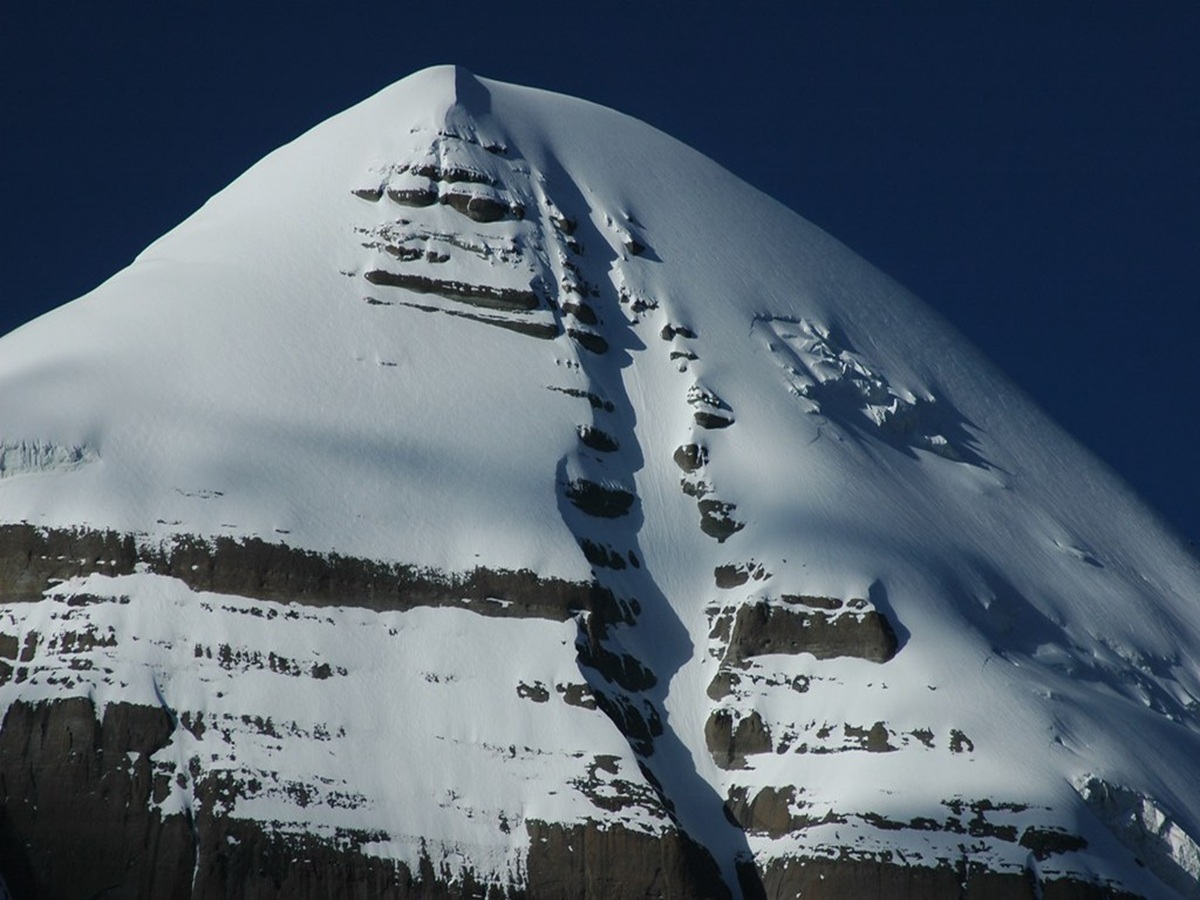
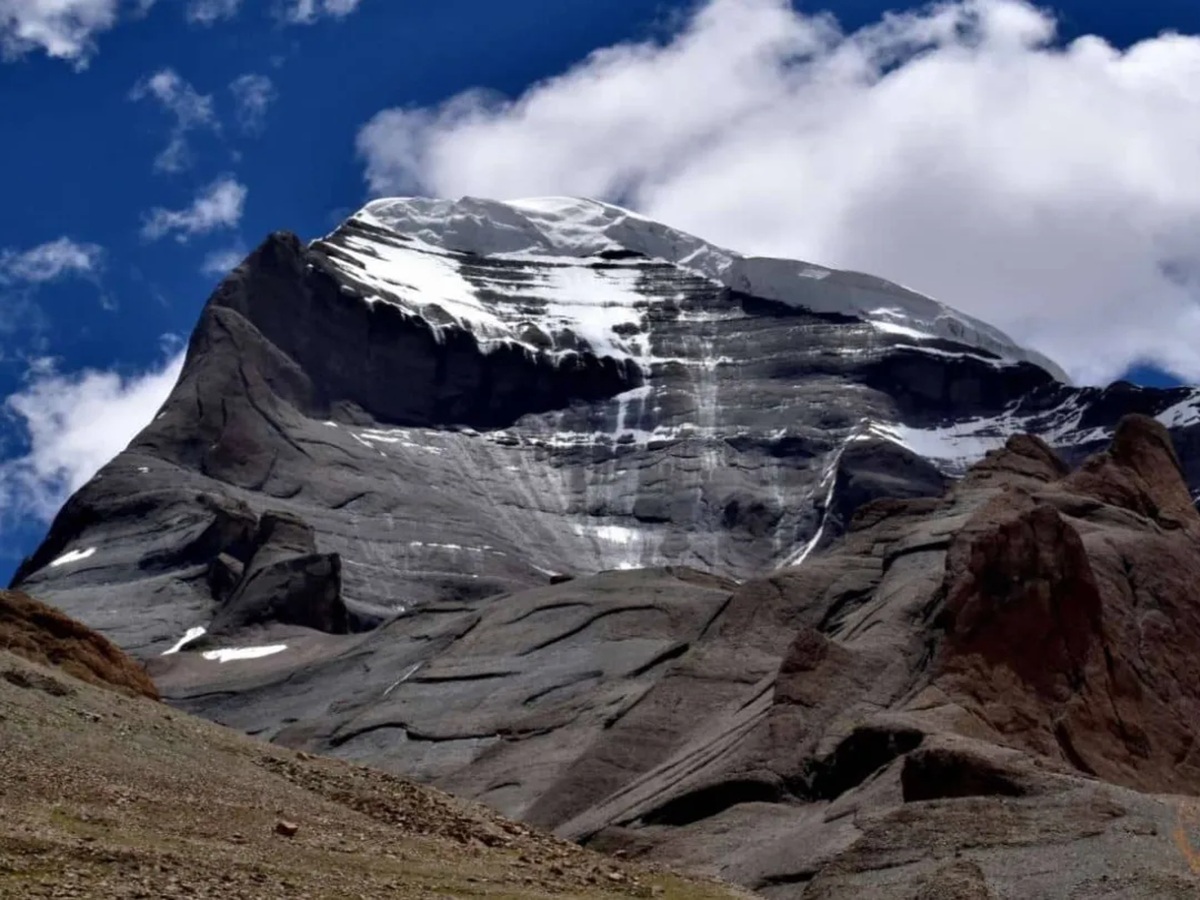
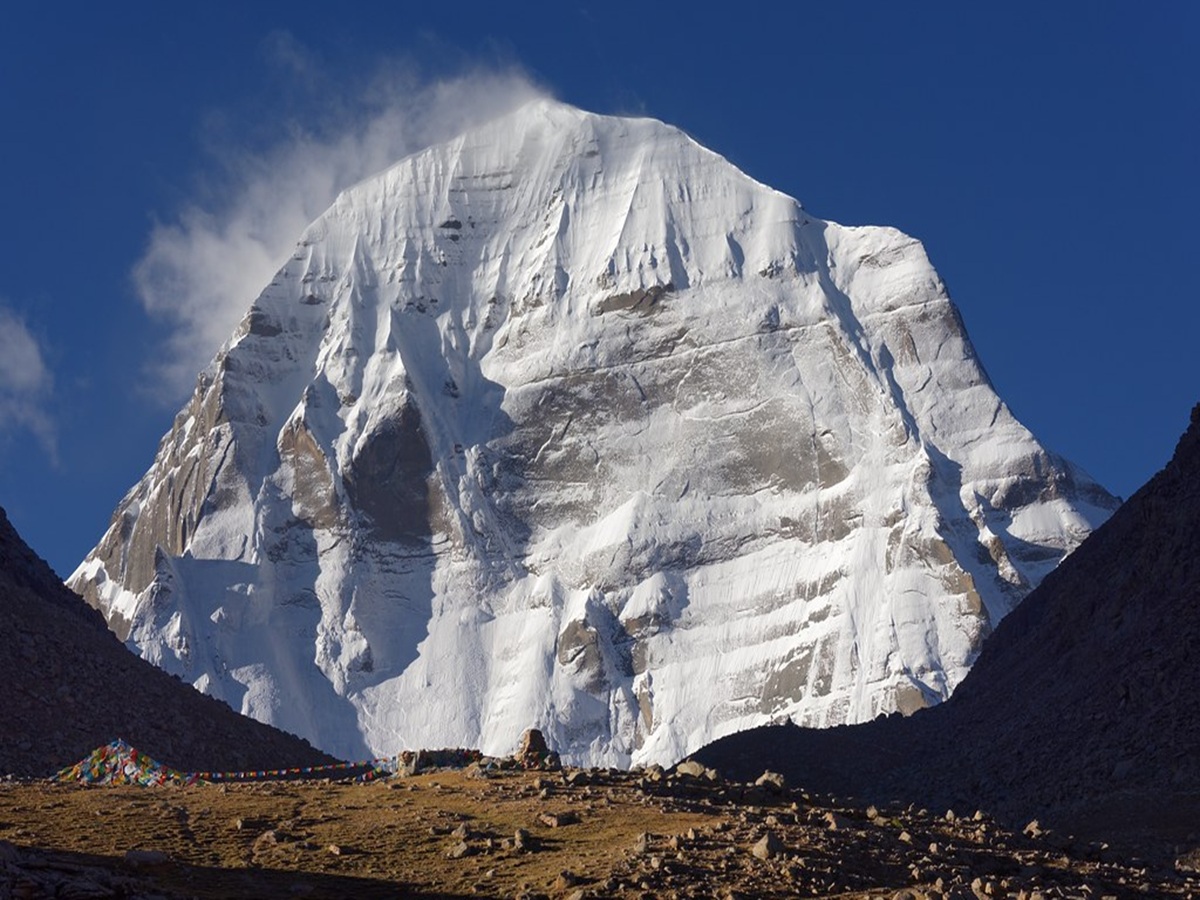
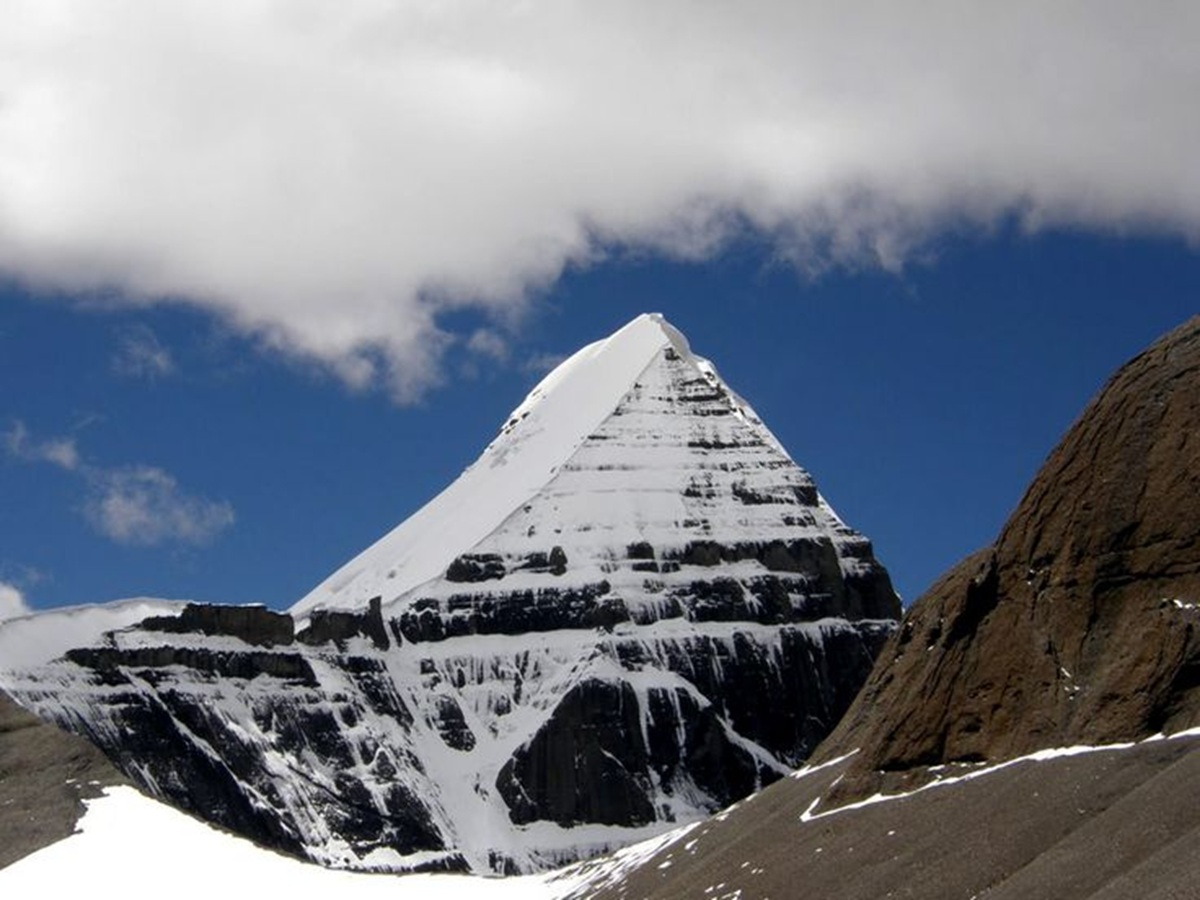
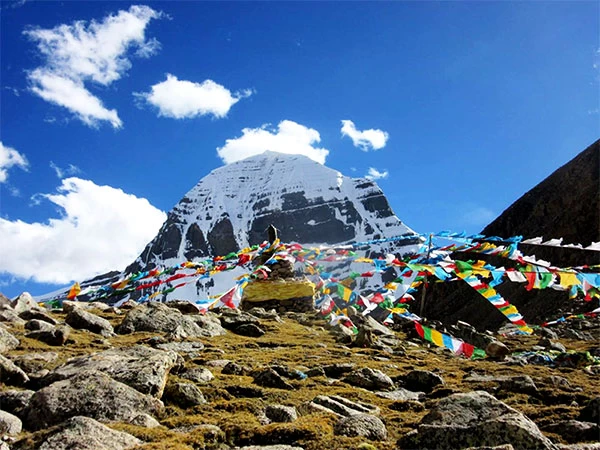
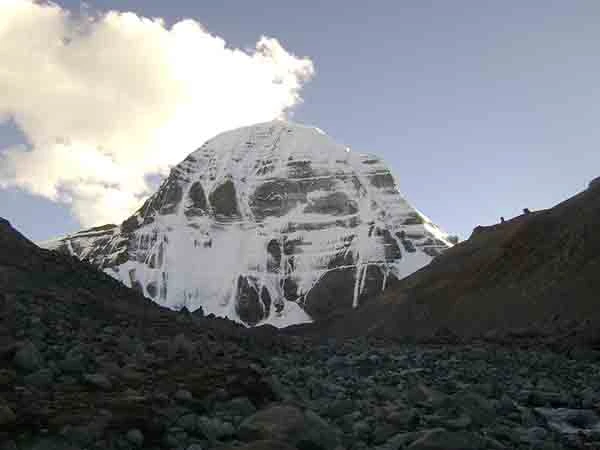
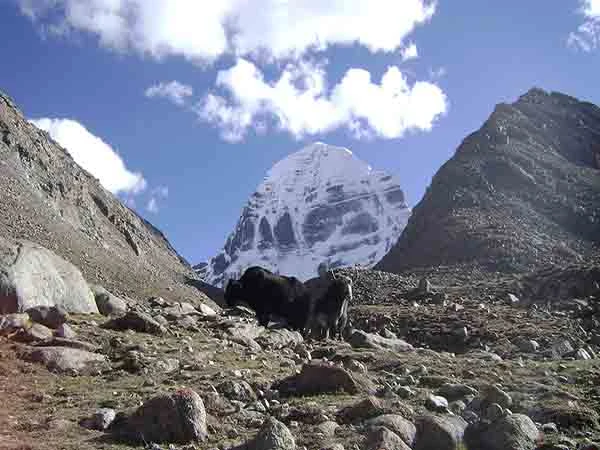
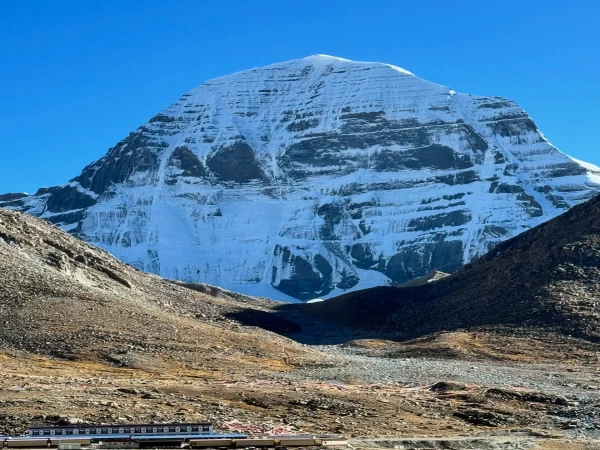
The sacred mountain of Kailash consists of 4 sacred directions: South, North, East, and West. Each direction has its corresponding gemstone or celestial jewel, and also represents an aspect of Shiva's divine personality, as well as representing a spiritual feeling in four major religions.
According to the Shiva Purana and Vishnu Purana, the Four Sacred Faces are: The South Face is Lapiz Lazuli, The North Face is Gold, The East Face is Crystal, and the West Face is Ruby. Thus making Kailash not a mountain but a living Temple of the Universe, carved out of Nature by Mother Nature herself. It's a vision that's hard to put into words.
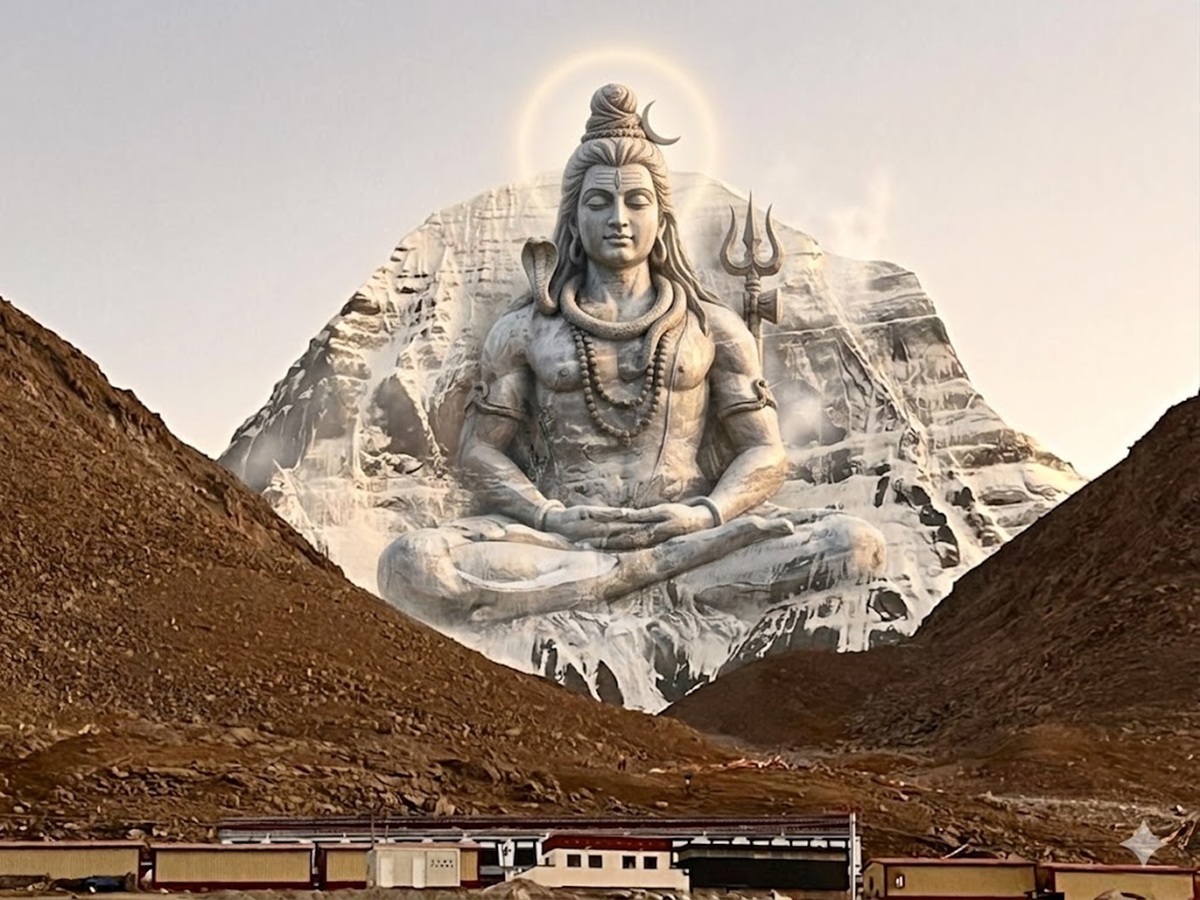
Mt. Kailash is located in the remote west of Tibet at 6,638 m. This mountain is the holiest of all mountains on this planet to the four major religions: Hinduism, Buddhism, Jainism, and Bonism. No one has ever climbed it. Climbing is not impossible, but climbing is illegal and sacred. Millions of pilgrims believe that the Spirit of Lord Shiva actually lives at Mt. Kailash, and that you can literally see Lord Shiva's Divine Face etched upon the rock and snow of Mt. Kailash’s South Face.
These four faces embody a profound uniqueness due to being revered for distinct reasons in their own unique belief systems.
Hindus worship Shiva's four faces as deified beings. Buddhist worship includes the four protective deities of each of the four cardinal directions. Jain worship includes the four different levels towards complete liberation, called Ashtapad.
The ancient Bon religion has four deities that represent the energy of balance between Earth, Heaven and man's relationship with Earth. All of which are positioned on the four sides of a mountain, bounded by four symmetrical circles of ice. These are called the four sacred stones of the Bon people. It's a vision of balance that has endured for thousands of years.
What are the Four Faces of Mount Kailash (Kangrinboqe)?
Kailash or Kangrinboqe, the Great Mountain, has four distinct faces aligned with the four cardinal directions: South face, West face, North face and East face. Each of these four faces represents a distinct direction and hence a distinct face of Mount Kailash.
Each face of Mount Kailash is viewed not just as a physical side of the mountain but also as a sacred manifestation of spiritual energy, spiritual symbolism (through each of the four religions of Hinduism, Buddhism, Jainism, and Bon) or presence (presence of spiritual being or power) that is expressed in these four separate faces.
South Face of Mount Kailash
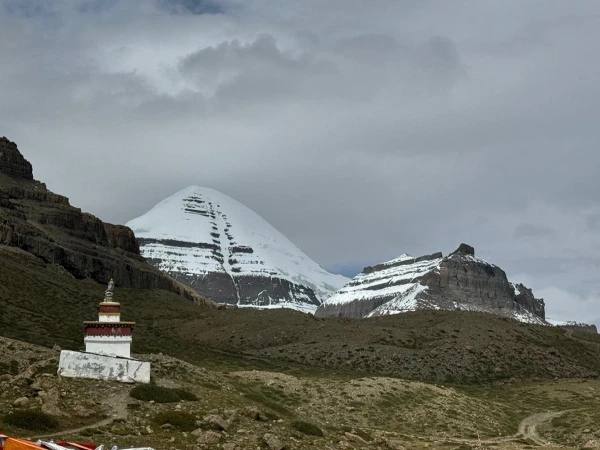
A divine view of the South Face of Mount Kailash
Many people regard the Face of Kailash as the most beautiful of all the faces of Kailash. When you view this Face of Kailash from a distance, it's easy to appreciate the symmetry and balance of the mountain, and many of those passing through the region for worship or travel express their admiration for the beauty of this Face of Kailash.
Physical Features
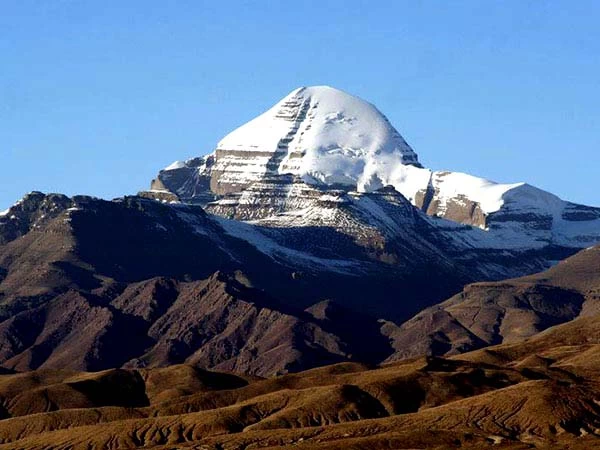
The Face of Kailash has a smooth and upright appearance and is characterized by its graceful and precise structure. The slopes above the central ridge are predominantly covered in snow, which adds to the overall appeal of this majestic face of Kailash.
When viewing the Face of Kailash, it is clear there are gorgeous straight lines produced by the rock face, which make this face of Kailash one of the most visually appealing faces of Kailash.
Spiritual Meaning
According to Hindu beliefs, the Face of Kailash represents the enlightening principles of spiritual strength, wisdom, and the divine energy of Lord Shiva. Pilgrims attending the Face of Kailash often attain peace, devotion and tranquillity whilst preparing for their sacred yatra.
Gemstone Association
The Face of Kailash is often associated with sapphire blue, which can be thought of as a sign of truth, depth, and devotion to the divine vision of the universe. The divine properties of this gemstone provide the Face of Kailash with a stunning natural beauty and an undeniably powerful spiritual presence.
West Face of Mount Kailash
The majestic West Face of Mount Kailash viewed during a sacred Mount Kailash Darshan journey
The West Face of Mount Kailash has been described as looking less fierce than the other three faces. Devotees often see this face as a reflection of emotional stillness, as well as compassion and devotion. They also generally associate this face with a peaceful feeling.
Physical Features
The West Face has a wider, softer surface and, according to some, the natural shapes of this face resemble a more human-like appearance than the other three. This aspect lends itself to a quieter overall visual impression than the other faces of Mount Kailash, and hence gives this face its own distinct identity.
Spiritual Meaning
From a spiritual perspective, the West Face represents compassion, healing, and a peaceful energy. Many pilgrims relate to this face as the embodiment of an emotional balance, as they complete their circumambulation (parikrama) of this Sacred Peak of Mount Kailash.
Gemstone Association
The West Face of Mount Kailash represents grace, abundance, warmth, and divine radiance because of its golden glow. This golden glow gives the West Face a calm, serene, and blessed spiritual quality.
North Face of Mount Kailash
The sacred North Face of Mount Kailash seen in clear weather during Kailash Mansarovar Darshan
The North Face of Mount Kailash is the most recognizable and spiritually intense face of Mount Kailash. It is particularly viewed from Dirapuk in awe of its dramatic and awe-inspiring presence.
Physical Features
The North Face's steep, powerful, and pyramid-shaped face makes it irresistible to many pilgrims. When viewed at sunrise, the North Face can appear to glow with a golden color. Thus, in devotional descriptions, the North Face is sometimes called "Golden Kailash".
Spiritual Meaning
For many pilgrims who make the Kailash Parikrama, the North Face of Mount Kailash represents power, transformation, and a significant spiritual energy.
Gemstone Association
Crystal and lapis lazuli (and other crystals) are associated with the north face of Mount Kailash, representing your integrity (purity), your clarity, your stillness, and your spiritual wisdom. The cool, glowing essence of these stones shows the strong mystical nature of this face.
East Face of Mount Kailash
The rarely seen East Face of Mount Kailash captured during Kailash Mansarovar Yatra
The east face of Mount Kailash has a mystique and sacredness based on the invisibility, hiddenness, and elusiveness of this side of Mount Kailash from view. It is frequently referred to as a face of silence, inner exploration and discovery, and higher levels of spiritual realization.
Physical Features
This face is primarily accessed by the Kora (Inner) route, making it more remote and not commonly viewed by many people compared to other faces. Due to its remoteness, the East Face of Mount Kailash is one of the most elusive to view faces of Mt Kailash.
Spiritual Meaning
There are numerous spiritual interpretations that depict the East Face as representing clarity, enlightenment, and awakening. Devotees generally associate it with deeper reflection and the last level of inward spiritual realization.
Gemstone Association
The East Face is predominantly associated with ruby red (the gemstone associated), representing energy, sacred fire, vitality and transformation are significant aspects associated with the spiritual nature of the face, with an emphasis on awakening and illumination (i.e., spiritual).
Kailash Parvar Four Faces Significance, Directions and Darshan and Facts to Know
Kailash Four Faces Facts
South Face
North Face
West Face
East Face
Direction
South
North
West
East
Sacred Jewel
Lapis Lazuli
Gold
Ruby
Crystal
Colour
Deep Blue Black
Blazing Gold
Ruby Red
Shimmering White
Emotion
Splendour and Liberation
Power and Strength
Compassion and Grace
Mystery and Clarity
Element
Fire
Air
Water
Earth
Hindu Form of Shiva
Aghora (Dissolution)
Vamadeva (Preservation)
Sadyojata (Creation)
Tatpurusha (Concealment)
River Born
Karnali (feeds Ganga)
Indus
Sutlej
Brahmaputra
Animal Symbol
Peacock
Lion
Elephant
Horse
Buddhist Significance
Wisdom
Spiritual Strength
Loving Kindness
Openness and Insight
Jain Significance
Liberation Stage 1
Liberation Stage 3
Liberation Stage 2
Liberation Stage 4
Best Darshan Point
Yam Dwar and Lake Rakshastal
Diraphuk Monastery
Day 1 Trail between Yam Dwar and Diraphuk
Descent from Dolma La Pass near Gauri Kund
Best Time to View
Sunrise and Dusk
Sunrise (Golden Kailash)
Sunset
Morning Light
Parikrama Day
Day 1 Start
Day 2
Day 1 Midway
Day 3
Special Feature
Natural OM symbol and Shiva spine visible
Real Shiva face formation in rock and snow
Serene compassionate human face in rock
Sacred Gauri Kund lake at its base
Spiritual Meaning
Moksha and transformation
Divine authority and purity
Protection and empathy
Rebirth and new beginnings
Why Does Mount Kailash Have Exactly Four Distinct Faces (No More No Less?
What makes Mount Kailash such a unique feature of the landscape is not only its distinct shape but also how perfectly aligned it is with the Earth's four cardinal points. Numerous geologists and researchers have studied Mount Kailash for centuries, trying to answer the question of why it has exactly four distinct faces.
Natural Geological Formation Explained
The four faces of Mount Kailash were a result of its horizontal layering of rocks and the eroding effect of time, weathering erosion along the natural fault lines of the rock mountain. Over a period of millions of years, the weathering of the mountain acted upon the natural planes of weakness of the mountain, resulting in a pyramid-like shape to the mountain.
In addition, the alignment of the four faces of Mount Kailash in their direction to the cardinal points of the compass was due to fault lines and uplift patterns occurring during the time of formation of the Himalayas.
How Glaciers Carved All Four Faces Simultaneously
During the last Ice Age, glaciers flowed in every direction around Mount Kailash, creating valleys and steepened mountains or mountainsides. However, glaciers did not create the four distinct faces of Mt Kailash. They enhanced and shaped the already established shape of the mountain as a result of the continued sharpening of all four corners of the mountain over time until they were more defined in appearance.
Why No Two Faces Look the Same
Erosion, sun exposure and snow accumulation cause every face of Mount Kailash to look different from the others. In addition to this, some faces receive more light than others, which ultimately causes the face to change in color and texture.
Other faces of the mountain are in shadow, obscured by ice and have very little light. There are also other characteristics, such as the type of rock that formed and how it eroded, that affect the shape and surface detail of Mount Kailash.
The Pyramid Shape and Its Mystery
Most peaks in the Himalayas are jagged and irregular; however, Mount Kailash has a geometric shape that forms a pyramid-like shape (four sides). The definition of the four sides of Mount Kailash is more geometrically well-defined than other mountains and is aligned to the four cardinal directions.
As a result, some people speculate about how Mount Kailash's shape was created; however, geologists often explain that the shape of the mountain is the result of several million years of erosion on the natural structure of asymmetrical, layered, sedimentary rock.
NASA Confirmed the Near Perfect Pyramid Shape
NASA satellite imagery of Mount Kailash from its Terra mission shows the near-perfectly pyramid-shaped nature of the mountain; however, NASA has not officially designated this mountain as a "perfect pyramid" or an artificial structure.
NASA has only officially stated that this mountain is a natural mountain that could be observed through the use of high-resolution satellite imagery.
The Man-Made Pyramid Theory
Some Russian researchers have theorized that Kailash is a human-created pyramid that is surrounded by several smaller pyramids formed by humans, but these ideas are purely imaginary and do not conform to current scientific standards.
Geologists generally believe that the symmetrical shape of Kailash is due to various physical factors such as normal natural processes occurring through time, the structure of the rocks themselves and processes that have taken place over long periods (e.g., weathering or erosion).
Alignment with the Four Cardinal Directions
The mountain Kailash is well known for having an exceptionally well-defined set of four surfaces, each matching up with one of the north, south, east or west cardinal directions. Characteristics like this are relatively rare in nature.
Instead of developing broadly defined peaks, the majority of mountains develop irregularly formed peaks as a result of significant diversity among mountains caused by unevenness in their erosion rates or tectonic movement.
The Near Perfect Cardinal Alignment
Through geological observations and satellite imagery, it has been confirmed that all of Kailash’s faces are aligned with the four directions; however, the typical assertions made about “perfect mathematical precision” are typically exaggerated.
Scientists have explained that these alignments occur naturally as a result of the rock structure, and due to the effects of erosion over geological time; while a clearly symmetrical arrangement like this is typically not the norm.
What Ancient Scriptures Said Thousands of Years Ago
Ancient texts such as The Vishnu Purana and The Shiva Purana describe a four-sided sacred mountain that is consistent with the four cosmic directions. Though mythological, many regard the similarity between the descriptions in these sacred texts and the reality of Mount Kailash to be quite impressive.
Why This Alignment Makes Kailash the Centre of the Universe
Mount Kailash is listed as the literal, physical representation of Mount Meru (the cosmic centre) in Hindu, Buddhist, Jain, and Bon cultures. Not only does this spiritual belief follow from Kailash’s four faces and directional alignment, but it is further verified that there are an extensive number of major rivers that also originate from Mount Kailash and flow away in all four of the respective directions.
Different Religions Perspective and Their Own Significance About the Four Faces of Kailash
Four separate religions with four very dissimilar ideas regarding the same four Rocks, ice, or Snow. Each Religion has its own belief for each of the four, without one having been dependent on any of the other for thousands of years.
Hindu Beliefs The Four Faces as the Four Forms of Lord Shiva
To Hindus, Mount Kailash is viewed not as a mountain formation of earth and stones, but as the equivalent of four faces of God Shiva and thus four expressions of the Divine's power: The Four Faces each possess a joint cosmic authority and express that power as an independent part of the original creation.
The Hindu text Shiva Purana describes Shiva's four faces as follows:
South Face (Aghora): This face represents death, dissolution and transformation; destruction of the ego, therefore freeing one's spirit. The natural symbol of 'Om' on this face, along with the upright spinal column of Shiva are said to be the most powerful signs of God on earth.
North Face (Vamadeva): This face represents preservation and divine stability; it is the eternal preserver of the universe, the cosmological yogi who holds the universe still whilst in the act of creating.
West Face (Sadyojata): This face represents compassion and creation. During dusk, this face emits a brilliant deep red colour, signifying Shiva's creation of all living beings, inspirational to those receiving from this face.
East Face (Tatpurusha): This face represents the hidden form of Shiva. It is translucent and has little access to those who have not achieved the required devotion to receive this face.
Buddhist View The Four Faces and the Axis of the Universe
Mount Kailash, or Kangri Rinpoche, is a mountain that is known to Tibetans as the Precious Snow Mountain. They also consider the four sides to be an extension of the four points of the compass on Mount Meru, which serves as the celestial center of all that exists.
There are four great protector deities (Lokapalas) that guard each side of Mount Kailash, and they are:
South Face: Yama, Lord of Dharma and Truth, is the protector of the south side
North Face: Kubera, Protector of Wealth and Abundance, is the protector of the north side
West Face: Varuna, Protector of Compassion and Universal Order, is the protector of the west side
East Face: Indra, King of the Gods and Protector of Spiritual Insight, is the protector of the east side
Jain Tradition The Four Faces and the Path to Liberation
Mount Kailash is a holy site for Jains because it is known as Ashtapad, the 8-step holy mountain. Jains consider it sacred because their first Tirthankara, Lord Rishabhdev, attained Moksha there.
For Jains, the four sides of Mount Kailash symbolise the four levels of liberation:
The South Side: The beginning of the journey to liberation (this is when the individual becomes aware of their path to liberation)
The West Side: The end of the journey to liberation (when the individual gives up worldly things)
The North Side: When the individual is on their way to becoming liberated (on their way to Moksha)
The East Side: When the individual reaches liberation (when they attain Moksha).
Bon Tradition as the Four Faces as Four Cosmic Pillars
The Bon religion, Tibet's pre-Buddhist spiritual tradition predating all four other faiths at Kailash , names the mountain Tise and sees it as a world soul, held up by four cosmic pillars corresponding to the four faces.
In Bon cosmology:
The South Face represents Fire's two pillars of transformation and spirit purifying.
The North Face represents the two pillars of Air, which are both power and purity.
The West face represents Water's two pillars of unconditional love and flow of healing energy.
The East Face represents Earth as the two pillars of life force, stability and starting over.
If You Can See Only One Face of Mount Kailash Which Is the Most Sacred for Darshan?
If you only see one face of Mount Kailash, the most blessed and powerful aspect would be the North Face. This is because the closest and most beautifully flat view that the pilgrims have of the mountain is from there when they reach Dirapuk on their journey to circle the mountain.
Many of the devotees believe the North Face is where the true divine essence of Lord Shiva can be seen. The North Face of the mountain is visually impressive and appears to be in the shape of a pyramid with a chin above the base. The mountain's beauty is enhanced at sunrise so much that it is referred to as "Golden Kailash," which adds an extra element of mystery to its magical appeal.
In addition to the external beauty of the North Face, there is also a profound spiritual meaning attributed to this part of the mountain, as it is believed to be where Lord Shiva resides. Pilgrims believe they have been blessed when they see the North Face of Mount Kailash.
In addition to the external beauty of the North Face, there is also a profound spiritual meaning attributed to this part of the mountain, as it is believed to be where Lord Shiva resides. Pilgrims believe they have been blessed when they see the North Face of Mount Kailash.
Another key reason for this is accessibility. When you visit the pilgrimage sites along the yatra route, you may be able to get a lot closer to the north face of the mountain than from any other side. Many people even try to do Chharan Sparsh (touch the feet) of the mountain so that they can have a more intimate and powerful experience.
All four faces of the mountain, the north, south, east and west, have a different spiritual meaning, but the north face has a superior spiritual meaning when it comes to visibility, darshan and energy compared to the other three. For many people, just seeing the north face clearly (without obstructions) once will provide them with enough of an experience to be spiritually complete.
North Face vs South Face Spiritual Debate Resolved
The debate of the North vs. South faces of Mount Kailash exists only because there are such different experiences associated with them. There is nothing better or worse about either side; however, they provide very different stages of spirituality throughout the Kailash Parikrama.
What Makes the North Face Spiritually Powerful?
The north face of Mount Kailash is regarded as the most vigorous and transitional aspect of the mountain. The North Face is also viewed from Diraphuk from a very close distance, making it the most direct point to view the North Face, or darshan. In the morning, the North Face often shines and is very pronounced. Its steep and symmetrical face creates a divine environment in many people's minds.
The North Face has the potential to symbolize strength, transformation, and elevated consciousness. Many people believe that when one reaches the North Face, they face their ego and move toward being enlightened. Additionally, many traditions associate the North Face with divine power or access to spiritual awakening.
Due to the close proximity, along with the fact that it is so visually prominent, many pilgrims will feel that they have the deepest connection to the North Face when they make their pilgrimage.
Why Is the South Face Equally Sacred?
The South Face provides a similar spiritual experience; however, it is a different one. It is also the first face that a pilgrim will see, indicating the start of their pilgrimage. The main feature of the South Face is its long, upward-rising ridge, which symbolizes the spine or strength of Lord Shiva.
The South Face embodies characteristics of stability, devotion, and grounding energy. It allows the pilgrim to prepare mentally and spiritually for the challenges that lie ahead. The South Face is completely opposite from the North Face, which is all about intensity. The South Face has a sense of stability, calmness, strength and reassurance.
Final Verdict: Which Face Is More Sacred?
Neither face “wins”. The South Face represents the beginning of a pilgrimage (faith and preparation), while the North Face is a symbol of transformation and realization.
As a unit, the two faces constitute the complete spiritual journey of the Kailash Parikrama — a pilgrimage that begins with devotion and culminates in a greater sense of understanding.
Is Lord Shiva still alive on Mount Kailash? Reality or Just a Myth
Lord Shiva on Mount Kailash
Many believe that Mount Kailash is the place where Lord Shiva resides, but to date, there is no scientific proof that he physically resides there. For Hindus, Shiva is not a being with a physical form or being on Earth, but rather a timeless and ubiquitous source of energy (cosmos), so in reality, defining that He is still “alive” is more spiritual than physical.
Devotees, however, believe, from centuries of reciting ancient scriptures and traditions, that Shiva is still alive, residing on the mountain in “divine” form, but is beyond our understanding because he is meditating beyond humanity.
What Do Religion and Science Say About Shiva’s Presence in Kailash?
Devoutly religious followers of Hinduism believe that Mt. Kailash is the eternal home and that God’s Goddess Parvati is one with God at Kailash while maintaining the cosmic balance. However, researchers view Mt. Kailash was simply a mountain- a natural mountain formation with no proof showing any divinity physically residing anywhere within.
Researchers attribute the “mystery” associated with Mt. Kailash to geography, isolation and cultural beliefs.
Is It Reality or Myth That Shiva Lives on Mount Kailash?
Whether the answer is yes or no depends on your perspective. However, if you are a believer, it is a living spiritual truth; if you are part of the scientific community, it is just a myth based on faith. Mount Kailash has a unique position because it is one of the few locations where faith and reality co-exist.
Although no one can see Shiva physically, many feel that he is with them every step of their travel.
Can I see the Real Mount Kailash Face on Kailash Parvat?
Yes, it is possible for pilgrims to view what many people call the ‘true’ face of Mount Kailash; however, there are some things that you need to know about Mount Kailash's four distinct faces. While completing the pilgrimage (Kailash Parikarma/Kora), devotees will view each of the four faces of Mount Kailash from their respective perspectives.
It is widely known that the so-called ‘Shiva Face’ of Mount Kailash is typically observed from its northern face and has a calm, serene countenance similar to that of Lord Shiva when viewed from Dirapuk on the pilgrimage.
The Four Faces of Mount Kailash That Pilgrims See
1. Shiva North Face: The “Shiva Face”
It is the most commonly seen face by all pilgrims.
The patterns on the rocks and snow at this point give the impression of Lord Shiva's face in meditation.
The best place to see it is from the Dirapuk Monastery during the course of parikrama.
Many pilgrims will tell you that this is the best way to see the divine form of Kailash.
2. Shiva South Face : The “Third Eye of Shiva”
As pilgrims approach the mountain, they usually notice this as one of the first major faces.
Some of the natural formations can be seen to resemble either the third eye of Shiva or a sacred line that runs vertically up Shiva's spine.
This face is visible from the area around Lake Rakshastal.
3. Shiva West Face: The Calm Guardian Face
As you hike along the parikrama route, you will see the West Side.
Some of the natural formations can be seen to resemble Shiva's face looking down upon the pilgrims with a watchful, peaceful expression; a compassionate expression.
The West Side has a different emotional feeling from the other three sides.
4. Shiva East Face: The Hidden Face
It is the least well-known and least understood face of Kailash.
The only time you can generally see it is while on the Inner Kora, an undertaking that few pilgrims do.
The formations on the Hidden Face are smoother and often have a symbolic meaning associated with purity, enlightenment, and spiritual rebirth.
What did NASA find on Mount Kailash Four Faces?
Near Perfect Pyramid Shape Confirmed
According to NASA, Mount Kailash captured high-resolution images through the use of the ASTER Satellite between 2015 and 2016 that show a tetrahedral shape that closely matches what is referred to as a "pyramid" shape (most pyramids you will find on Earth are tetrahedra). The high-resolution images of Mount Kailash have been verified by independent sources and confirm that it has a tetrahedral, pyramidal shape.
Four Faces Aligned to Cardinal Directions
North, South, East, and West. This information also corresponds with ancient texts, the Vishnu Purana, that were written thousands of years before any modern measurement systems.
Lord Shiva's Face Formation on the North Face
NASA Terra images of the north face of Mount Kailash revealed several rock ridge formations and their associated shadows resembling an enormous human-shaped face, appearing to be Lord Shiva. And the most defining feature is that it can only be seen during the hours of sunrise. You'll want to be up early for that.
Powerful Electromagnetic Anomalies Detected
Satellite imaging has recorded electromagnetic anomalies coming from Mount Kailash. This means that the mountain has enough electromagnetic energy radiating from it to cause erratic behavior with compasses, disrupt GPS, malfunction with electronic equipment, and prevent aircraft from flying over it.
Unusual Thermal Signatures Across All Four Faces
In 2018, satellite infrared images showed that there were notable differences in the temperature measurements of the four sides of Mount Kailash (the mountain itself was formed as one large structure). This difference in temperature or thermal asymmetry has led scientists to propose theories for its existing conditions.
Hollow Underground Areas Detected by Radar Mapping
Radar imaging from satellites carried out upon Mount Kailash has indicated to researchers that this location has many underground cavities with potential for extensive tunnelling networks, thereby providing ample reason for them to be speculated about. Unfortunately, the absence of any formal investigation into underground structures/tunnels has meant that the true extent of these phenomena cannot yet be conclusively determined.
The Mountain Sits on Multiple Major Tectonic Fault Lines
Based on InSAR radar measurements similar to those of NASA's NISAR project, scientists have been able to establish that Mount Kailash is positioned at the intersection of several active tectonic fault zones. These are suspected to be one of the contributing factors resulting in Mount Kailash's geometric disturbances. It's a reminder that even sacred ground is always shifting beneath our feet.
Kailash Aligns with Global Sacred Sites
Upon analysing all data matrixes created from satellite measurements or image geometry, it can be inferred that Mount Kailash has a geometrical relationship and mathematical alignment to several major sacred geographic locations on Earth. Including the Great Pyramid located at Giza, the altar of Stonehenge and the North's geographic pole. So it represents one of the most mysterious geographic occurrences found anywhere on the planet. Some things can't be explained away as coincidence.
Source of Four Major Asian Rivers Confirmed
The location of four of Asia's greatest rivers has been confirmed. NASA's Terra satellite image has confirmed that the ancient Hindu
Accelerated Ageing Reports Near the Four Faces
Scientists, including those studying NASA's electromagnetic data, recorded the fact that persons near Mt. Kailash reported that their nails and hair grew faster than normal rates, growing approximately two weeks in 12 hours of time. This leads to speculation that some form of anomalies can be found in proximity to Mt. Kailash, either magnetically or gravitationally and that they affect/have affected the human body and perception of time.
Getting Darshan of All Four Faces of Kailash During Kailash Mansarovar Yatra and Parikrama
The Kailash Mansarovar Yatra is unique in that pilgrims can see all four sides of the mountain from four different locations along the route. Pilgrims will see all sides of the mountain at different times of the day as they walk up the mountain. The pleasure of seeing all four sides of the mountain is due to the fact that they will be awarded the privilege to see this beautiful site after completing their journey.
Kailash Yatra Phase 1: Viewing South face
You will arrive at Darchen at the same time as the South Face of Mount Kailash. When you arrive at Darchen, you will not have to walk up to the South Face, climb to a greater altitude, or use any special means to make this beautiful sight available to you.
The South Face is also a beautiful sight from the shores of Lake Mansarovar, as on a clear, windless morning, the South Face of Mount Kailash is perfectly reflected in the dark blue waters of Lake Mansarovar. Many pilgrims who see this beautiful reflection will tell you that it was one of the most beautiful sights they have ever seen in their lives.
Face: South Face
Where: Darchen, Yam Dwar, Lake Mansarovar
Day: Pre-Parikrama
What to Do:
Do a Pranaam facing the South Face of Yam Dwar from the place where you start your pilgrimage.
Chant the mantra "Om Namah Shivaya" 108 times (the sages claim that each time you do this, it reaches to the omnipresent Shankar, or Shiva, directly from here).
Slowly pour well-watered and pure offerings from Lake Mansarovar onto the faces of the South and West Faces of Mount Kailash. This is one of the most auspicious acts that a devotee can perform at Mount Kailash.
If you are unable to walk the entire length of the Kora, please sit at Yam Dwar to meditate in the direction of the South Face for at least 20 minutes. This, from just that one Dharsan, will provide you with some of the same karma as would occur from performing a partial Kora.
Kailash Yatra Phase 2: West Face Darshan
After leaving from Yam Dwar, if we continue walking in the clockwise direction along the path, the South Face gradually gives way to the West Face. In the evening, it appears to be glowing with a deep ruby red colour as the sun sets. And it's the hardest section of Day 1. But it continues to watch over every step we take as we go through the Kora. On those long stretches, you'll find comfort in knowing it's there.
Face: West Face
Where: Trail between Yam Dwar and Diraphuk
Best Moment: Sunset
What to Do:
Regularly view the West Face - you will notice that it has different colors and emotions every hour.
When experiencing strong emotions (crying, relief, etc.), sit facing the West Face and just breathe. Sadhus call this 'Shiva's compassion washing your previous karma.'
At sunset, chant "Om Namo Bhagavate Rudraya" in front of the West Face.
Kailash Yatra Phase 3: North Face Darshan
Pilgrims leave the trekking lodge at Diraphuk Monastery (4,860m) at dawn to step out into the open and see the North Face blazing with gold, filling the whole sky. Most pilgrims will say that they have come to Kailash to witness this moment of sheer beauty called "Golden Kailash".
Face: North Face
Where: Diraphuk Monastery
Best Moment: Sunrise
What to Do:
Rise early enough to see sunrise: The golden light lasts only a few moments, and many people who have made pilgrimages say they will always be sorry they did not wake up in time to see the sunrise.
Complete a Sashtang Pranaam: by lying on the ground flat and facing the north face of Mount Everest.
Chant Har Har Mahadev loudly.
Sit for 30 minutes in silence and meditate: This is the single most powerful point of meditation for the entire Yatra.
Kailash Yatra Phase 4: East Face Darshan
After crossing Dolma La Pass (5,645m), pilgrims will come down, and they will be able to see the East Face, the only view of it, glistening crystal clear from Gauri Kund. The view is fleeting; it comes into view quickly and disappears quickly. No one but those who have completed the Kora can see the East Face.
Face: East Face
Where: Descent from Dolma La Pass toward Gauri Kund
Best Moment: Morning descent
What to Do:
As soon as the East Face is visible, stop, stand still and look at the crystal impact for a few seconds (just a few moments) before moving on.
When at Gauri Kund, place flowers and/or sacred Ganga Water into the sacred lake (the holiest offering you can make to Lord Shiva) at the foot of the East Face.
Make your most personal, deepest prayer to Lord Shiva at Gauri Kund. (It is believed that any honest prayer made at Gauri Kund will reach Lord Shiva immediately.)
Say "Om Gam Ganapataye Namaha" (a reminder that you are at the place where Lord Ganesha first emerged).
If you are intrested check our diffrent Kailash Packages to view the all four faces of kailash: