The Kailash Mansarovar Yatra is one of the greatest pilgrimages in the world, leading us to the secluded Tibetan Plateau, which reaches an average height of over five thousand meters. Given the changeable weather that can fall upon the region, the fluctuation in temperature can be quite high between day and night. Thus, it becomes pertinent to pack sensibly.
Carrying appropriate clothes, medicines, and other personal belongings helps to be relaxed and concentrated on the holy expedition instead of getting worried about preventable things.
At the same time, overpacking can also bring along certain discomforts. The luggage becomes difficult to manage during transshipments, transit during the crossing of the border, and also during trek portions of your journey during the Kailash Yatra.
Consult your tour company on what gear is provided (duffel bags, oxygen facilities, transportation, etc) in your yatra package. Many times, your package often covers several things, which can save you money and space. We guide you on exactly what to take with you, and what not to.
What should I Bring for a Trip to Kailash Mansarovar?
This is the essential information you should bring when on the journey. It can be read fast when you lack time, and later look at the comprehensive packing list below, if you have enough time.
The list includes garments, your medications, trekking gear, and the basic goods essential to survive at high altitudes.
Some valuable equipment like: permits, supporting group gears, and group accessories, will be provided by Dream Tibet Travel as stated in detail in the checklist below, if you have additional time to read that list.
Equipment Overview
Items provided by Dream Tibet Travel
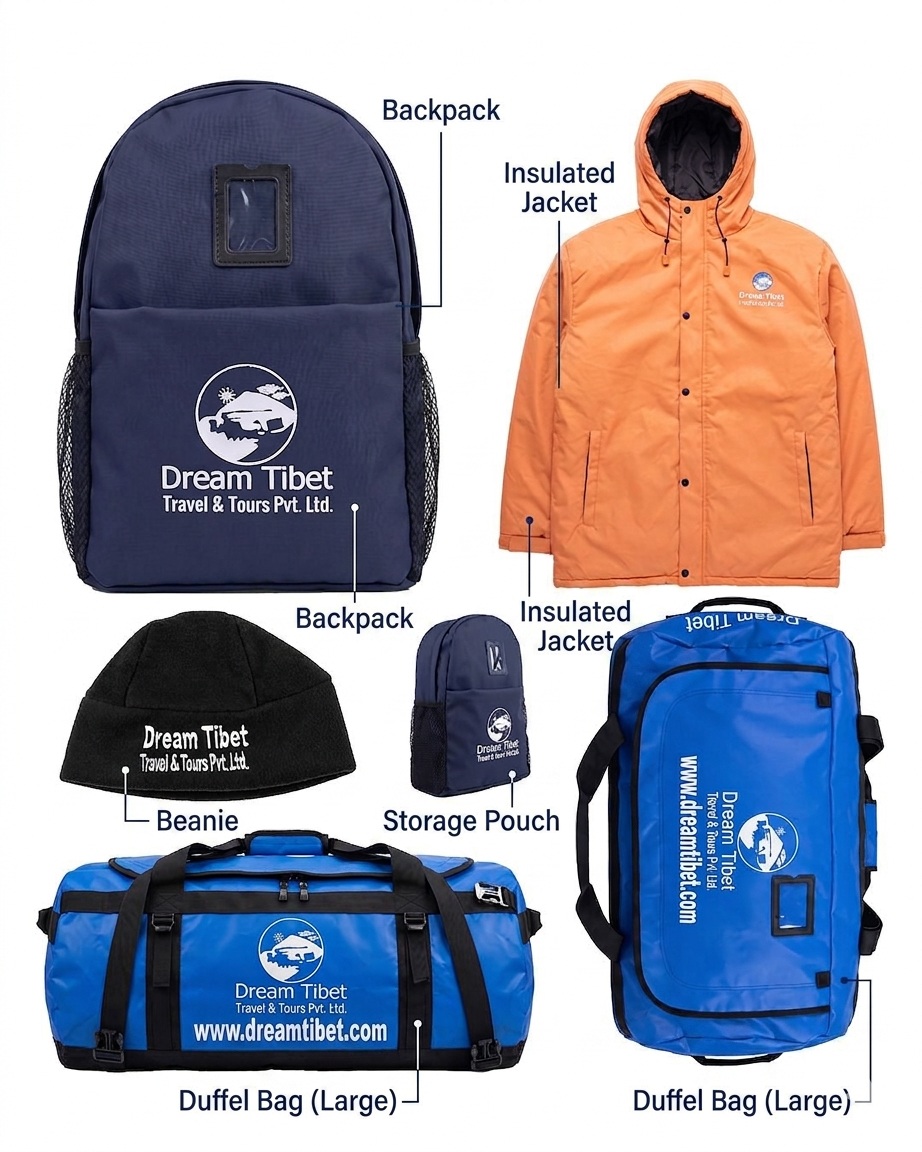
Backpack / Daypack (navy blue) - 1
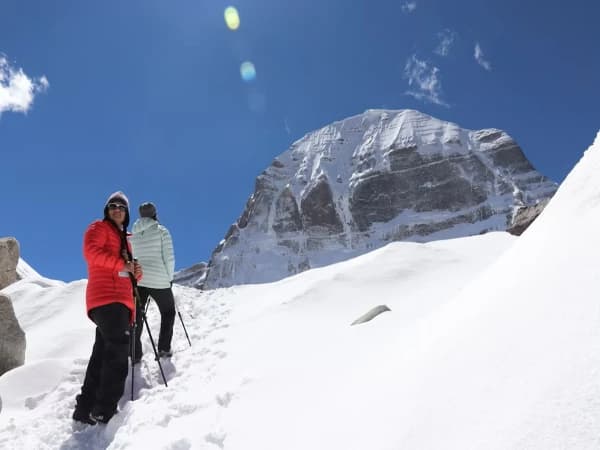
Hooded insulated jacket/parka (orange) - 1
Fleece beanie/winter cap (black) - 1
Small backpack - 1
Waterproof travel duffel/expedition bag - 1
Essential Clothing
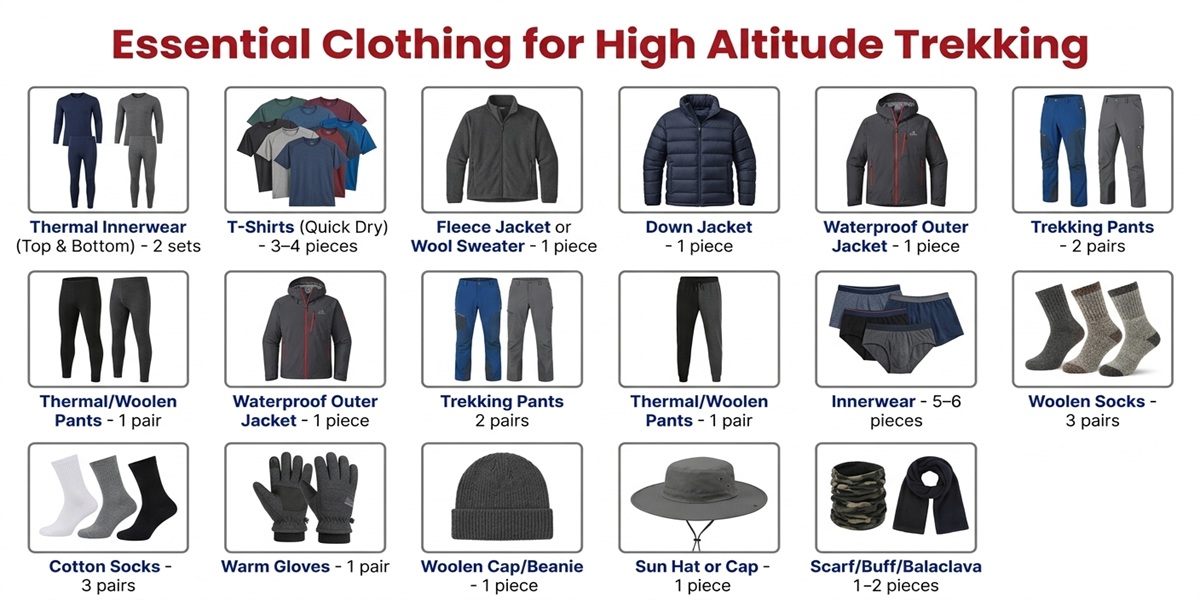
Thermal Innerwear (Top & Bottom) – 2 sets
T-Shirts (Quick Dry) – 3–4 pieces
Fleece Jacket or Wool Sweater – 1 piece
Down Jacket – 1 piece
Waterproof Outer Jacket – 1 piece
Trekking Pants – 2 pairs
Thermal/Woolen Pants – 1 pair
Innerwear – 5–6 pieces
Woolen Socks – 3 pairs
Cotton Socks – 3 pairs
Warm Gloves – 1 pair
Woolen Cap/Beanie – 1 piece
Sun Hat or Cap – 1 piece
Scarf/Buff/Balaclava – 1–2 pieces
Footwear
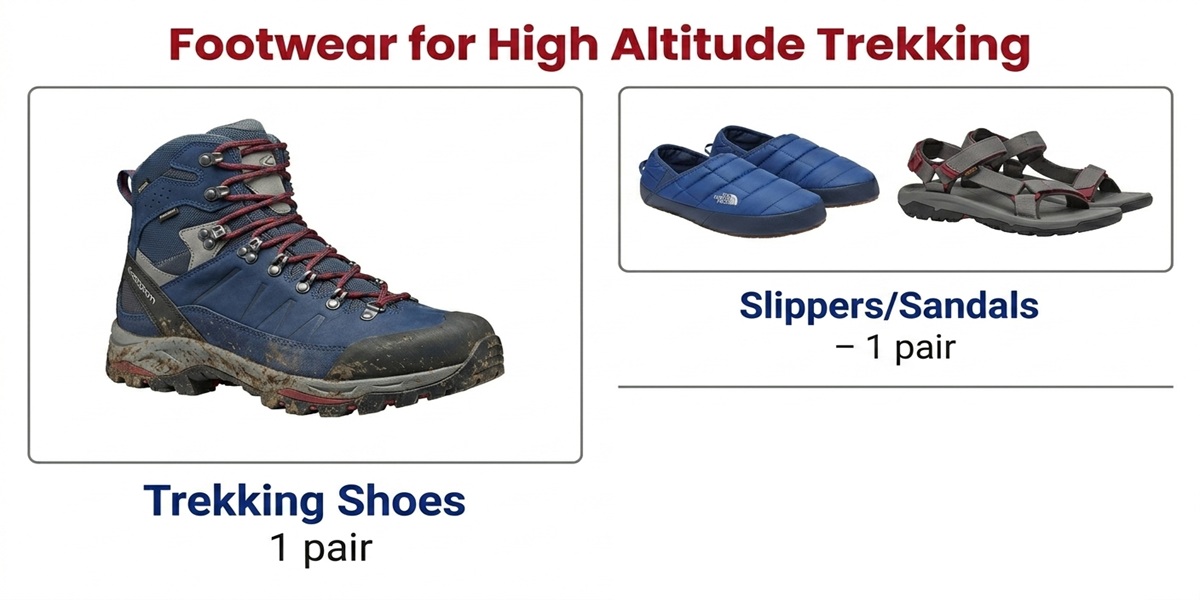
Trekking Shoes – 1 pair
Slippers/Sandals – 1 pair
Bags & Storage
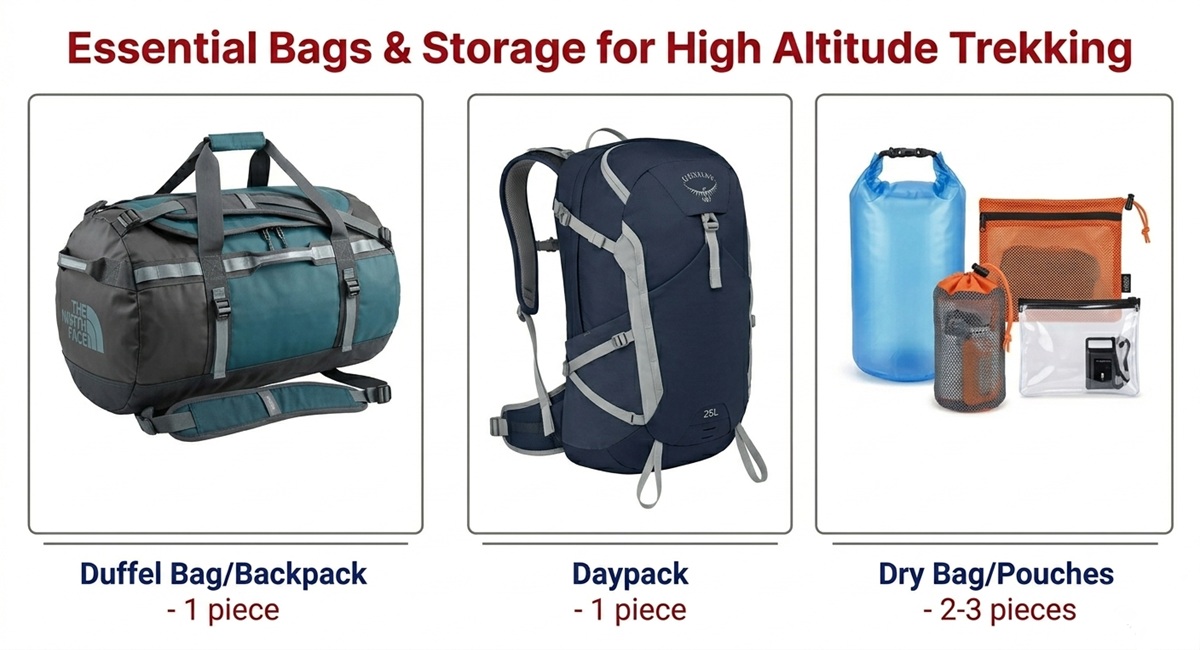
Duffel Bag/Backpack – 1 piece
Daypack – 1 piece
Dry Bag/Pouches – 2–3 pieces
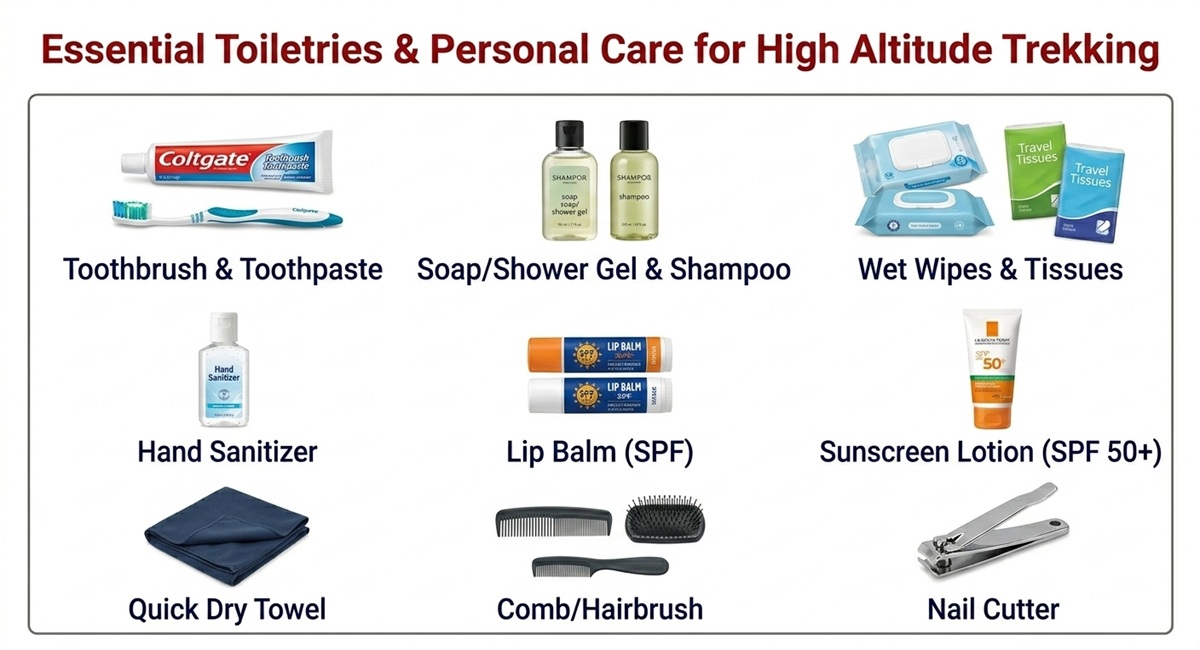
Toiletries & Personal Care
Toothbrush & Toothpaste – 1 set
Soap/Shower Gel & Shampoo – 1 small bottle each
Wet Wipes & Tissues – 2 packs each
Hand Sanitizer – 1 bottle
Lip Balm (SPF) – 1–2 sticks
Sunscreen Lotion (SPF 50+) – 1 tube
Quick Dry Towel – 1 piece
Comb/Hairbrush – 1 piece
Nail Cutter – 1 piece
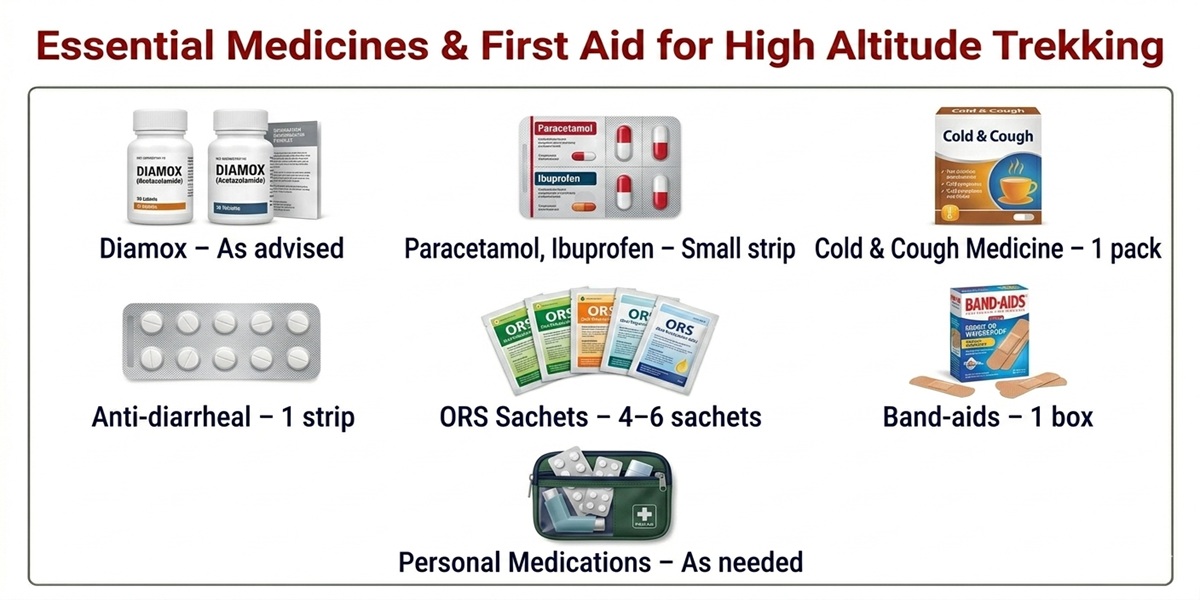
Medicines & First Aid
Diamox – As advised
Paracetamol, Ibuprofen – Small strip
Cold & Cough Medicine – 1 pack
Anti-diarrheal – 1 strip
ORS Sachets – 4–6 sachets
Band-aids – 1 box
Personal Medications – As needed
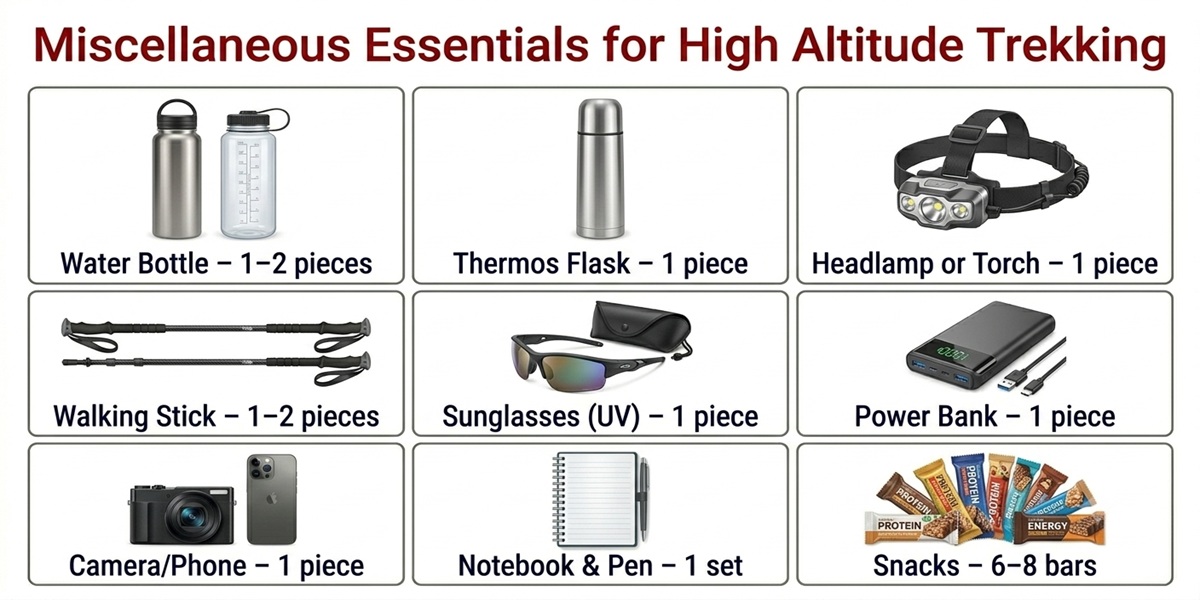
Miscellaneous Essentials
Water Bottle – 1–2 pieces
Thermos Flask – 1 piece
Headlamp or Torch – 1 piece
Walking Stick – 1–2 pieces
Sunglasses (UV) – 1 piece
Power Bank – 1 piece
Camera/Phone – 1 piece
Notebook & Pen – 1 set
Snacks – 6–8 bars
Documents
Passport (Original) – 1
Passport Photos – 4–6 pieces
Photocopies of Passport/Visa – 2 sets
Travel Insurance Copy – 1 set
Emergency Contact List – 1
Optional but Useful
Prayer Beads – As needed
Earplugs & Eye Mask – 1 pair each
Face Mask or Buff – 2–3 pieces
Items Provided by Dream Tibet Travel and Tours for Kailash Mansarovar Yatra Pilgrims
Items provided By Dream Tibet and Travel Company for kailash Pilgrims
This is one huge benefit of travelling with Dream Tibet Travel and Tours, many of the most crucial and most costly pieces on your own packing list are going to be offered by us, so there is no need to obtain these at your homes prior to travelling with us. Listed here is what you can acquire once you’ve obtained Kathmandu on arrival.
Backpack / Daypack
A durable navy blue coloured backpack with the Dream Tibet Travel and Tours logo on the front. Main compartment of good size, front zip pocket to easily get to your important essentials, and mesh side pockets on either side at the correct height to take your water bottles/thermos flasks. This is going to be your everyday pack for the duration of the trip and needs to stand up to the wear and tear of both a long day on the bus or the whole day's walking around the Parikrama.
Hooded Insulated Jacket / Parka
A bright orange coloured insulated jacket with a hood and the Dream Tibet Travel and Tours logo emblazoned on the chest. The jacket is waterproof, windproof, has a front button and zip fastening, large hand pockets, and a hood with a toggle to protect your head, and is designed to withstand any adverse weather conditions and altitude. You do not need to buy your own extra jacket.
Fleece Beanie / Winter Cap
A warm, cozy, and lightweight black fleece beanie with the Dream Tibet Travel and Tours logo emblazoned across the front. This hat comes in at any time when the mercury dips and does not leave until we shed heavy winter layers as temperatures begin to ascend on high altitudes or during our morning & evening stay at the guesthouse. A tiny thing, but it is an immensely valuable asset for travelling.
Waterproof Travel Duffel / Expedition Bag
A rugged waterproof blue coloured expedition duffel with a black reinforced handle, heavy buckle straps, and the Dream Tibet Travel & Tours logo & website prominently placed on both its faces. Crafted from heavy-duty PVC tarpaulin grade material, it is completely water-resistant & huge in size for all your belongings to fit with ease for 15 days duration of the trek. This is your principal baggage for the whole trip.
Essential Clothing Required for Mount Kailash Trip
Diffrent Clothes To pack for Kailash Trip
Let us now look into the specific details of the key clothing essentials for the Kailash Mansarovar Yatra. Clothes: This is indeed a hot topic among most travelers. After all, you will be going to high altitudes for about 14-15 days, and layering of clothes is a crucial aspect.
Here is a simple rule: layers, layers, and layers.
This single concept would serve as your savior throughout the entire journey and would take care of the dramatic changes in temperature that you would experience throughout the day.
Thermal Innerwear
Your thermal innerwear is the base layer of your clothing system, the foundation of everything you wear for the Kailash Mansarovar Yatra. Pack two sets- one top and one bottom per set. You’ll want to ensure you always have a dry, clean set available. Do not buy synthetic thermals.
Synthetic fabric traps moisture next to your body, preventing it from breathing properly. At extreme altitude, where the air is already arid, trapping moisture against your skin will quickly force your body toward dehydration. Cotton, on the other hand, allows your body to breathe, naturally regulates body temperature without working against you, and effectively provides the warmth you require without the risks of synthetic fabric. This cannot be stressed enough, as it will affect everything you wear above it.
T-Shirts
Pack 3 or 4 quick-dry t-shirts for the trip. These wear over your thermal base layer for warmer stretches of your journey, as well as functioning as your primary top layer on mild weather days. Quick-dry fabrics are necessary here due to the extremely limited access to laundry facilities, and being forced to spend an entire journey in a sweaty t-shirt is out of the question.
The vast majority of outdoor gear stores will carry them for affordable prices – you will be surprised at Decathlon’s price range. Include some personal t-shirts for your travel days or for any days you spend resting at the guesthouse. 4 to 5 altogether would be a very reasonable quantity to take along.
Fleece Jacket or Wool Sweater
One fleece jacket will work as your middle layer, resting over your thermal inner wear but under your outer shell jacket. It is your go-to item when the late afternoon chills set in, in the morning before setting off for a trek, or when you stop on the Parikrama.
Fleece is lightweight and easy to pack into a small space while still providing significant warmth. A decent fleece also allows you to throw it on and take it off easily in rapid increments, a capability you will want in the shifting mountain climate.
Down Jacket with Hoodie
Your down jacket will be your go-to insulator for the truly cold parts of the trip. High on the Kailash trek, you'll find it really chilly during the nights on the route, as are the hours before dawn for the Parikrama, and so a down jacket is a must.
What should I look for in a down jacket?
Look for a high fill power, 600 fill or better, and an ideal option that packs into its own pocket - this helps keep it light and out of your way when it is in your day pack. It is important for your hip to be covered; it will make a significant difference in keeping your core warm. One with a good hood to give you protection if there is a strong wind on the windswept Tibetan plateau would be beneficial.
A good hooded insulated jacket is provided by Dream Tibet Travel & Tours on this yatra, so check with us first if we can equip you with one.
Waterproof Oversize Outer Jacket
This is your protective outer layer. Everything else hangs off the fact that your outer jacket is windproof, waterproof (and thus sleet and snowproof). On the Kailash route, wind is actually usually the greater issue than rain. This whole vast, exposed Tibetan Plateau with its cold winds can chill you to the bone much faster than you anticipate.
What you probably need to know before shopping is that good-quality, actually waterproof jackets are hard to find at rock bottom prices – and what are advertised as ‘waterproof’ are actually water repellent – good against a shower, not a steady downpour. This will be sufficient, but windproofing is essential (anything you bring must be windproof.) A waterproof, windproof outer jacket is provided to all travellers undertaking the yatra with Dream Tibet Travel and Tours, and it is suitable for Kailash and specially made for this trip – you need to buy your own before you travel.
Trekking Pants
Pack two pairs of trekking trousers, and pack however many you can comfortably. You will spend many hours in a bus from Nepal through Tibet, to Kailash, and the trekking trousers are much more comfortable than regular trousers or jeans for the duration. For walking and especially across the Parikrama, you will be able to have freedom of movement, and they dry faster if they get wet.
The walking trousers are very useful, especially while on the walking part around the Parikrama, where for the length of hours you're walking, across the ground, there is lots of moisture in the air, and it will be wet walking there. The Parikrama is best walked in these, mostly long rides on the bus, which are much better for these trekking trousers.
Thermal or Woollen Pants
A pair of thermal or woollen pants rounds off your bottom layering. These are worn beneath your trekking trousers once the temperature dips sufficiently– think an early morning start to the Parikrama, chilly halt areas during rests, or cold nights at guesthouse lodgings along the way. Much like the thermal inner top, stay away from synthetic materials here.
Wool or cotton thermal undergarments regulate the body temperature well at higher altitudes and help keep things working normally through a day of long exertion.
Innerwear
We recommend carrying five or six innerwear items. Given the limited opportunities for laundry on the two-week-plus Kora, rotating with ease just helps you maintain basic personal hygiene standards through the two weeks. Opting for a quick dry innerwear helps just like in the case of t-shirts.
Woollen Socks
Buy and bring three pairs of woollen socks. Woollen socks are much warmer than cotton, and they help to carry the moisture away from the skin much better than cotton socks, also they are much better during longer sections of walking. It will feel better during those days if you spend hours on your feet, so you bought three pairs.
Three pairs will give you enough change over the course of your trek. In case it becomes wet when you cross over streams, etc. Or in the rain, the other two pairs keep you going without any trouble. The three pairs will come in very handy for you to change between, so your feet are not wet during walking day or during the time that you spend at high altitude, so be ready to make sure your additional spare socks are packed in your day sack on walking day.
Cotton Socks for Daily Wear (Until Mansarovar and Return)
Three pairs of socks made of cotton, along with woollen. For walking days, rest days, and travelling to the hotel in the afternoon/night. It's less warm but more airy and light.
Gloves (One Warm Fleece Pair and One Waterproof/Windproof Pair)
Warm gloves are an indispensable item. Your extremities get a considerable amount of exposure over the Kailash route, whether walking, taking pictures, or just standing around at altitude. Cold hands at best, or a significant problem at worst when the temperatures nosedive on the plateau, will certainly detract from the experience.
They should offer outer wind-proofness with inner insulation. It's worth ensuring that they are warm enough for sub-zero temperatures but still retain sufficient dexterity. Being able to operate your phone or camera with them on will come in handy on the Parikrama.
Woollen Cap or Beanie
Carry at least one woollen cap or beanie. You lose considerable heat through your head at altitude, and this small item provides one of the most effective and portable ways to retain your warmth. Put it on whenever it gets cool, snug it up inside your hood in strong wind, and wear it in bed on cold nights at high altitudes. Dream Tibet Travel and Tours include a fleece beanie in your equipment.
Sun Hat or Cap
In addition to the cozy beanie, bring a sun hat or cap. These have completely different roles to play. During the day, in the bright, harsh UV light of the open Tibetan plateau, you really don't want to burn your skin. UV light is about three to five times more intense at 4000m than it is at sea level. On long, often featureless stretches of trekking, you'll see nothing but wide, empty Tibetan sky above you.
It's not hard to see where all the sunshine is going. A baseball or other sport cap that shields the eyes by having a forward brim is the best all-around option, although some trekkers like to have something like a safari hat. What matters most is that it stays securely on your head - the wind in many parts of Tibet can be strong and unrelenting.
Scarf, Buff, or Balaclava
Take one to two for the neck, nose, and ears. Of the whole list, this item may be given more thought than any other. You must keep these three regions protected 100% of the time throughout the entire route.
These three throat, nose, and ears must be protected constantly against the ceaseless wind that blows across the Tibetan Plateau; and having your airways covered takes pressure off the respiration system at high altitude.
A buff is probably the most versatile option. It can act as a neck warmer, pulled up over the nose and mouth, and can serve as a lightweight head covering as conditions dictate. A balaclava offers complete covering, and for early Parikrama mornings where wind and low temperature make one truly wince at exposed skin, one really is priceless. It helps to take one each.
What Footwear To Take For Holy Kailash Mansarovar Tour?
Best Tour and Treking Shoes
Below are some of the essential details regarding Footwear for your Kailash Mansarovar Yatra. Most of the traveller overthinks or completely overlooks Footwear. The rule on Kailash Mansarovar Yatra for Footwear is straightforward: two pairs.
One pair for trekking, one for general-purpose use.
Trekking Shoes (Well-Broken-In Trekking Shoes/ Avoid New Shoes to Prevent Blisters)
At the very least number of shoes needed per person is a pair of waterproof trekking shoes for use while on the Parikrama and walking along the route.
Having waterproof trekking shoes is a must during the Kailash Parikrama. The Kailash Parikrama has roughly 52 kilometres that need to be walked over three days at altitudes consistently above 5,000 metres. The terrain consists of rough, loose rocks, streams, and mud, as well as a steep climb up and down Dolma La Pass (5,636 metres). Your feet will remain dry no matter what the weather condition is like on your journey.
It is best to avoid wearing the same pair of trekking shoes throughout the whole trip.
There will be long periods of travelling by road in Tibet as part of the Kailash Mansarovar Yatra, and when you spend extended periods of time sitting on a bus, your trekking shoes will be very uncomfortable for such long periods of time. Trekking shoes are designed to be rigid and heavy and to move about on trails (not for hours of sitting in a bus). Reserve the use of your trekking shoes only when you really need them.
What should I look for in a trekking shoe?
Buy fully waterproof, not water-resistant, walking shoes. Waterproof hiking shoes and boots are affordable to buy at outdoor shops, such as from home or in Kathmandu. The shoes should have strong ankle support - especially important if you’ll be trekking over uneven terrain on the Parikrama for 3 consecutive days. They should have deep tread or lugs for purchase on slippery rocks or loose ground. Lastly, buy shoes from home before travelling.
Whilst you’ll be able to buy in Kathmandu’s Thamel area, stock varies hugely, and you might be pressured to take the closest size to what you need, regardless of the right fit and support for your feet. Trekking boots need fitting properly, a bit of walking in them inside a store, and breaking in, all of which you absolutely can’t manage on arrival in Kathmandu. It's best to buy one size larger than your actual size.
The Right Size Trekking Shoe
The right-size trekking shoe deserves its own mention. Your feet swell at altitude. This is a well-documented physiological response to decreased oxygen and to exertion, and it is the nemesis of many trekkers. A perfectly fitted shoe at sea level can become uncomfortably tight on day 3 of a 5000 m walk. Buy your trekking boots a half to one size larger than your actual foot size. Wear the same weight woollen socks on which you intend to perform Parikrama, and go for the size that will fit the socks on the boots.
Ill-fitted trekking boots on higher altitudes result in pressure points, poor blood circulation, reduced mobility, and make blisters quite common on a multi-day walking expedition. This is probably one of the easiest things one can do for the safety of one’s feet.
Slippers or Sandals with Good Grip
Bring one pair of slippers/sandals for everyday non-walking days.
After a long bus or train journey, change your stiff trekking boots into a pair of soft slippers, and it makes all the difference to your foot’s recovery for the next day. In the guesthouse room and the toilet, you cannot always walk with your trekking shoes on, and you also may not be comfortable using public toilets bare foot. Here comes the use of these slippers.
But there is a very important point that your slippers or sandals must have a good grip on the sole. Numerous locations along the route, as well as outside the guesthouses, involve outdoor walks with varied terrain (slopey walkways, wet surfaces, loose gravel, dust particles on rough stone pavements). One needs a good grip to maintain footing at higher altitudes, even in non-trekking wear.
Flat-soled slippers on a slippery surface can cause nasty accidents, and these can be hazardous, especially at higher altitudes. Opt for a sandal or slippers with a textured, grippy rubber sole.
Which Are The Best Shoes for Kailash Mansarovar Yatra?
For any traveler who is planning a Kailash Mansarovar trip, selecting the right shoes would be one of the biggest priorities. You need to endure walking 52 kilometers of difficult terrain at altitudes above 5,000 metres. On a holy journey to Kailash Mansarovar, one would also need to cross uneven, rocky areas, streams, and snow, along with the steep path that is required to climb up the Dolma La Pass at a height of 5,636 metres and go down it. Not only do incorrect shoes lead to blisters and ankle injuries, but they can also cause a condition that can terminate your journey.
Best Overall: Salomon X Ultra 4 GTX
There is always a place in everyone’s bag for Salomon X Ultra 4 GTX. If you go and research, you will see this to be the topmost option for the trek to the Himalayas because Gore-Tex waterproofing membrane protects you completely from water, and also this gives optimum traction because of Contagrip Sole to all types of muddy, rock paths, Uneven, Loose soil, etc that you come across during Parikrama. Also not too heavy, you can wear it with complete comfort all day long.
The support on your ankles would be great without any restriction in your movement. Investing in these trekking shoes is all you will have to invest for the long journey of the Kailash Mansarovar yatra.
Best Budget Option: Decathlon Quechua MH500
If your budget doesn't stretch as far, but you still want a solid waterproof trekking shoe for your trek, then the Decathlon Quechua MH500 cannot be overlooked. With a waterproof coating, good grip for mixed mountain terrain, and adequate support for the price, this shoe will more than suffice for most people. As with most things sold by Decathlon, it's readily available and easy to try on and test walk before purchasing. It won't compete with a high-end shoe on tricky mountain passages, but you don’t want to pay for more than you need for the relatively straightforward trek that is the Parikrama.
Best for Wide Feet: Keen Targhee III Waterproof
The Keen Targhee III Waterproof Keen are famed for producing trekking footwear with a wider toe box, which generally makes their shoes one of the more suitable options for wider feet. With Keen’s own waterproof membrane, multi-directional lug sole for traction, and a metatomical footbed designed to mould to the foot shape, you really get bang for your buck with this versatile shoe. As with many wider fitting shoes, this could be of added benefit at altitude, where the tendency for feet to swell could lead to painful pressure points with narrowly fitting shoes.
Best Lightweight Option: Altra Lone Peak ALL-WTHR Mid
Those who are used to a more natural, lighter feeling underfoot will find this shoe a fantastic choice for their trek. Altra is well-known for its zero-drop platforms and wide, foot-shaped toe box, which, for many, alleviates issues like numb toes and feet when tackling long distances much better than conventional trekking boot designs. In the ALL-WTHR version, this design is also waterproofed and features their reliable MaxTrac sole to provide traction on all manner of surfaces.
They’re lighter weight too, reducing fatigue across a 3-day trek along the Parikrama more than more heavily constructed trekking boots would. These suit those who are already accustomed to natural or minimalist footwear.
Best for Extra Ankle Support: Lowa Renegade GTX Mid
If you have had trouble with your ankles in the past, or just prefer a bit more support from higher-cut boots whilst traversing the unpredictable ground of the Parikrama, there are few shoes as widely respected as these. The Lowa Renegade offers a robust, mid-cut upper that offers great protection without hindering flexibility, combined with the proven Waterproof protection of their Gore-Tex lining. The outsole is made by Vibram, arguably the leading outsole manufacturer in the trekking world. While they are heavier than some others on this list, the protection that their higher cuff and superior outsole offer can make them worth it if ankle support is a top priority.
Bags and Storage
Bags to Consider for the Kailash Trip (If you are not using our provided bags, you may choose from these options)
Now, the most essential items bags you have to pack for the Kailash Mansarovar Yatra. The most simple rule to this entire trip is - you always need two bags. While one bag will carry all the bulky items, the second bag comes to you on a daily basis and carries almost nothing but just two or three crucial items that make this journey a bliss to remember forever.
Duffel Bag
Kailash Mansarovar Yatra always requires a duffel bag. Not a suitcase, nor a regular travel pack, nor a rucksack. A duffel bag, being pliable and easy to stuff into vehicles, lying flat rather than awkwardly perched up in the vehicle along the long Tibetan roads, is the correct format for this type of expedition. Dream Tibet Travel supplies you with an excellent quality waterproof duffel bag when you arrive at Kathmandu, so don't worry about buying one from home.
They are specifically designed for the climate encountered on the Kailash expedition. They are amply sized to accommodate sufficient gear for a 15-20-day trip and, by means of the waterproof construction of this pack, everything packed inside remains completely dry, whatever the conditions. No amount of water gets into the inside of it. Your pack travels in the vehicle on road stages and always lies ready for you when you arrive at each lodging location throughout your overnight stays. Make an arrangement such that your regularly used items are near the top of the duffel pack and stuff the things that you won't be utilizing until your next guesthouse right at the bottom.
An organized pack can save you significant amounts of both frustration and time throughout a journey that takes around 14 to 15 days.
Daypack
The bag that follows you everywhere–on the bus, on walk-outs on the path, on the Parikrama round Mount Kailash, etc., is your daypack. A daypack is also included as part of your Dream Tibet Travel and Tours packing list, thus no need to worry about buying the bag. It is your daypack where the day-to-day essentials rest.
The same could vary from a thermosflask, waterbottle, snacks, lipbalm, sunscreen, sunglasses, a camera, power bank, your documents, plus a layer that may need to be put on or off at any time as the day progresses and weather shifts.
Stay Organized and Light. The point of it is that all the things that will need to be accessed throughout the day should be in plain and easy reach instead of having to reach into your duffle bags every couple of hours.
What should I look for in a daypack?
You will be provided with a daypack by Dream Tibet Travel and Tours, so no need to stress about buying one, but it’s useful to know what is considered important. Padded shoulder straps: The padded straps of your day pack are important for carrying for hours when you are on the Parikrama days.
Essential gear includes water, energy snacks, your warm-up layers, and your guide. Dream Tibet travel can supply a daypack for the walk if you need to carry your equipment. Wide, padded shoulder straps are good, as you may be carrying a pack for long hours on Parikrama day. The chest strap adds to balance in difficult places. Various compartments make finding it much easier, and water resistant. There is a poncho in addition provided by Dream Tibet travel and Tours in case of torrential downpour. Your day pack will be your best friend during the Parikrama. You are spending long hours hiking high in the mountains, and it is really convenient to have access to water, snacks, energy bars, and warm-up layers without stopping for extensive packing or unpacking.
Dry Bags and Pouches
Pack two or three dry bags or pouch sets. It’s cheap, portable, compact, yet useful. Dry bags make it on the trip with your luggage for so many reasons. It snows, sleet, and rains on you on this Tibetan Plateau. Carrying a wet bag on a long yatra is also a concern. So keeping categories separate in dry bags will keep items protected within. See it as your personal space inside your duffel. Here's an idea on how you can do this:
A Dry Bag for Electronics (Phone/Camera/Power Bank, etc.)
A Dry Bag for Documents (All Paper Goods)
A Dry Bag for Spare Clothes (especially on Parikrama days when changing from being wet to being dry).
By putting wet clothes from splashing, etc., into a dry bag immediately, all other dry clothes will remain completely dry and unspoiled due to the wet clothes.
Those who have travelled at high altitude have experienced this and will tell you it is far more important than it sounds. Bring more than you think is necessary. You'll use everything you brought with you.
Toiletries and Personal Care
Toiletries and Personal Care Items Not to Miss
Here now are the personal care essentials you will need for the Kailash Mansarovar Yatra. This is easy – pack light, pack smart and don’t forget the items that don’t seem big. In high altitude and dry air, your skin and body get treated in unexpected ways, which only occur once you get there.
Toothbrush & Toothpaste (Regular Toothbrush Will Do)
One set is enough; keep this item at the very top of your toiletry bag. While it’s true that facilities are basic along the way, there is water at every stop, so you only need travel-sized toothpaste for a 15-day tour.
Soap, Shower Gel & Shampoo
Keep a single bottle of each; these are to be used in basic bathrooms (with intermittent hot water, so don’t aim high) to wash up after being on buses and doing walking tours. Make sure you use a small plastic bottle to store the contents of big ones – it saves considerable space in your backpack.
Wet Wipes & Tissues
Have two packs of each and readily available at the bottom of your day pack (ready for all occasions). In circumstances where you'll have absolutely no chance of washing, you will have them on hand to get you through the day. They serve all your dirty/smelly/messy needs from cleaning sticky fingers to making you feel less grimy after a 12-hour overnight coach ride. Don't make the mistake of not having these readily available.
Hand Sanitizer (Small one, and if you do not want to buy refill from a Larger Bottle at Home)
Keep one bottle handy in your day pack and take good care of it. This is so you do not have to carry your bigger pack, which saves you much effort. Good hand-hygiene can really keep you safe from stomach infections and similar problems, which you will need a lot at meal times.
Lip Balm (One layer of SPF and another layer of Vaseline)
Bring at least one or two sticks of sunscreen lip balm (minimum SPF 30) to protect your lips while you are in Tibet, since the air is extremely dry and the sun's rays are very strong because you will be at a high altitude. If you do not use sunscreen, your lips will crack/cut, and bleed, which is no joke. Please reapply throughout the entire day, even when your lips are not dry yet.
Sunscreen Lotion (If the sunscreen bottle feels heavy, you can use a hack: carry sunscreen in small balloons instead of a bottle. Fill sunscreen into balloons, tie them securely, and carry them easily in your bag.)
The item you’ll want to make sure you have packed is sunscreen to avoid getting tan and a sunburn. On the open Tibetan Plateau, the altitudes of 4,000-5,600 meters or 13,000 to 18,000 feet are where the sun rays are very severe, and UV radiation can get through to your skin. You can’t escape from UV radiation at these altitudes.
Pack an SPF 50 or higher sunscreen (the higher, the better) and apply generously to your body every morning prior to stepping outside. You should apply sunscreen throughout the day, especially if you are going to be outdoors for extended periods of time (in this case, on the daily Pilgrimage route to these holy places).
Quick Dry Towel
Put the quick-dry towel on top of your backpack. Since Tibet has a very cold and dry climate, you would do no more than waste space by bringing along a cotton towel, because cotton towels soak up moisture, so they take a while to dry in a cold environment and can sometimes get that musty, damp smell to them. However, quick-dry towels (these are often very thin and take about 5 minutes to dry) are perfect for the purpose.
Comb or Hairbrush
One piece. Easy and small. Space-saving with this one. Yours personal best friend for a 15-day journey, pocket-size comb fits anywhere.
Nail Cutter
In regard to nail clippers, this is something that is often overlooked until we need one and cannot find it. They are very small and light, so they can easily fit into your luggage and will remove a small, yet real, inconvenience from your travels.
Medicines and First Aid For Kailash Yatra
Important Medicines to Pack
Now, let's look at what types of medicines and first-aid supplies you should take on your Kailash Mansarovar Yatra. First and foremost, remember that Dream Tibet Travel and Tours brings a fully trained team of medical professionals with the yatra and are available to all groups. You will not be alone when traveling. However, it is wise to bring your own personal medicines with you. Your personal medical issues are solely your responsibility; the medical/first aid team will handle emergencies and medical situations for the group. Your personal medical supplies are a backup to the team's supplies.
Diamox
Diamox is frequently the preferred drug for altitude sickness prevention, and it is essential to know what it does before taking it. It enables quicker breathing, which, in turn, allows your body to adjust to low oxygen at altitude. The Kailash Parikrama goes over 5600m on the Dolma La Pass, meaning that altitude sickness can occur for anyone, irrespective of level of fitness.
You should not self-prescribe Diamox. You must see your physician before your trip to determine if Diamox is appropriate for your circumstances and take it as instructed by your physician. Some people experience side effects of increased urination or the sensation of tingling in their fingers, both of which are expected side effects. People who have allergies to sulpha or sulfonamide medications are not candidates for the use of Diamox, so your doctor will need to provide you with an alternative medication.
Paracetamol and Ibuprofen
Have with you a small strip of both. Paracetamol is what you want for fever, headaches, and discomfort at altitude; whereas ibuprofen is for the reduction of swelling and other pain (more severe than discomfort). These two forms of medicine are the most commonly used at any given time during an expedition at high altitude; therefore, you will frequently be reaching for these to treat one form or another of pain. The Dream Tibet Travel medical staff have a supply of these as well; however, by having your own strip of each, you will never have to wait or have to ask someone else for what you require.
Cold and Cough Medicine
Pack one small pack. The Tibetan Plateau is high and dry; you may have a minor cold or cough during your travels. By catching it early and taking medications they will help improve how you feel on subsequent days. Don't wait until your symptoms are bad before you medicate with cold and cough relief.
Anti-Diarrheal
Carry one strip of anti-diarrheal aids. Your diet, water, and altitude can affect your digestive system, causing an upset stomach. If you are upset it will be very difficult to travel while hiking and not have a place to go to the bathroom. Taking one anti-diarrheal pill doesn't address the underlying problem; it will help manage the symptoms until your body has an opportunity to adjust. Keep them in your daypack so that you can reach them quickly.
Oral Rehydration Salts (ORS) Packs
Make sure to take four to six sachets to replenish the minerals that are lost through sweating, urinating, and breathing (especially at high altitudes). The air is so dry and oxygen is so thin that dehydration happens much quicker than you'd expect, plus your level of physical exertion while on the Parikrama will only add to your rate of dehydration. Mixing an ORS sachet into your water bottle will help you rehydrate more quickly and replace the electrolytes you lost due to mild dehydration. The sachet is light, takes up very little space, and will serve a genuine purpose on your journey.
Band-Aids
You only really need a small box of them, as you and everyone else in your group will likely develop blisters, small cuts, or minor abrasions on the high-altitude trails during the next several days. The medical team with Dream Tibet Travel and Tours will carry full packs of first-aid supplies, and having your own box will allow you to take care of a blister or cut quickly without waiting for someone else to assist you. You may also want to keep a few loose Band-Aids in your daypack for the days you will be doing the Parikrama.
Personal Medications
The most important section for travelers already on medication is this one. Prior to departing, your doctor should be consulted. You will need to let them know where your journey will take you and how far above sea level the area will be. Ask them for a prescription for sufficient quantities of medications to cover the duration of your trip, and for a few days beyond as a buffer.
Keep your prescription letter with you during your travels; do not put it at the bottom of your duffel. Carry it in your jacket or daypack, so that it can be produced if you have a medical problem while traveling.
If a medical emergency occurs while you are traveling, the Team from Dream Tibet Travel and Trek will be able to assess and treat you much better if they can see what medications you are currently taking.
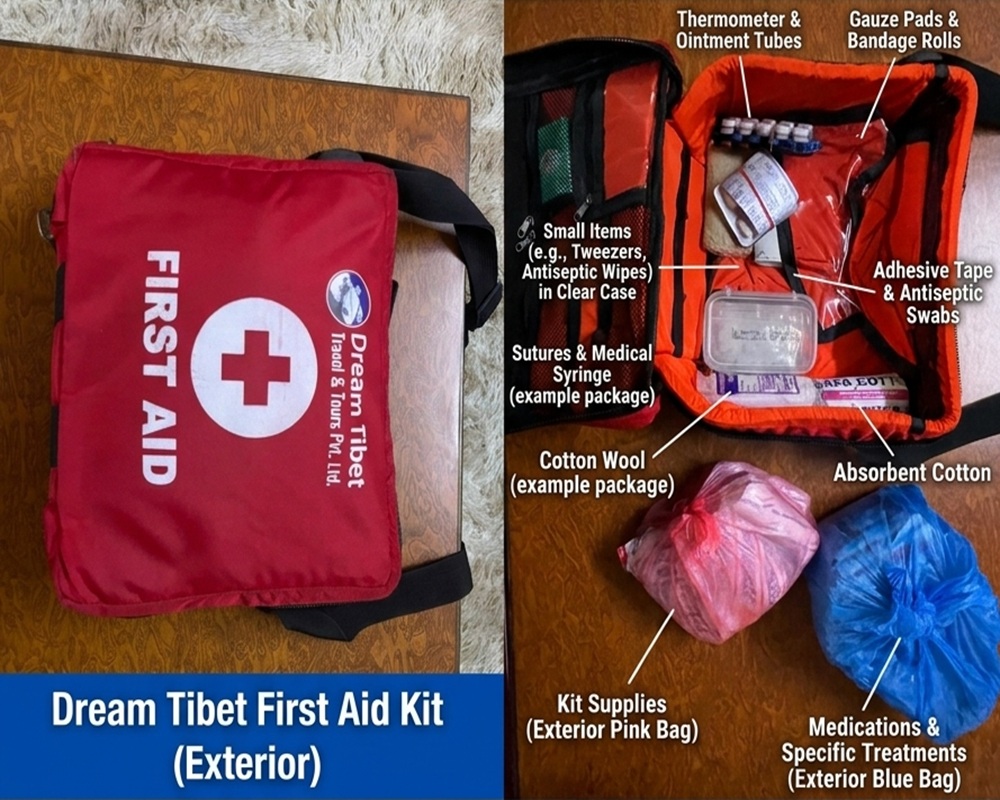
Medical Kit Carried By Dream Tibet Company
Medical Kit Carried By Tibet Travel Operator Dream tibet and Travel
Miscellaneous Essentials To Take Along With You On Your Kailash Yatra
Miscellaneous Essentials
The following inventory includes the miscellaneous essentials needed for the Kailash Mansarovar Yatra; these are the items that may not fit nicely into the clothing or medications you've packed but are the items you use most often during 14-15 days of travel on this route.
Water Bottle
As you travel through Tibet, be sure to keep at least one or two water bottles with you. At every stop along the way, Dream Tibet Travel and Tours provides you with warm water; this is how you will transport your required amount of water from your last stop until you fill up again. Drinking cold water at high elevations can irritate your stomach and cause your body added stress; however, drinking warm water always has a positive effect, so making sure you have a refillable bottle while you are travelling long distances through Tibet will ensure that you will never run out of hydration.
It is critical that you maintain hydration levels throughout your trip, as the air on the Tibetan Plateau is very dry. Your body will lose fluids more rapidly at higher elevations than at lower elevations, and dehydration is the primary cause of altitude sickness. You should drink fluids consistently throughout the day and do not wait until you feel thirsty to drink.
Thermos Flask
This is an extremely handy item for keeping your drink hot over many hours. It complements your water bottle. Dream Tibet Travel and Tours ensures there’s hot water available at each stop, and your thermos is for the transport of that hot water through long sections between points where you can refill.
Especially useful on parikrama days, a flask of hot water or tea out on a desolate trail at 5000 metres makes all the difference to a challenging day. Always fill it at the beginning of the day.
Headlamp or Torch
This will feature on your list of useful gear for the entire time you are out of your house. The accommodations on the Kailash trip consist of small, rudimentary rooms and sometimes no rooms at all, with lighting very rare and basic. During the dark hours, you might be tempted to venture outdoors for a trip to the loo, at which stage having two free hands because of a headlamp will feel like a major luxury at altitude.
The Parikrama days frequently begin very early indeed, and you will walk for hours in the dawn light, often still in pitch darkness, so a headlamp is crucial. Opt for a powerful beam and ensure you take plenty of spare batteries, as it can get very cold in high-altitude areas, and you will use batteries faster.
Walking Stick (Mainly for the Parikrama; it helps carry your body weight, making your feet feel lighter. Also during downhill sections it reduces vibration and impact, helping you stay stable and comfortable.)
You can buy a pair or even two trekking sticks, but there is no point carrying them with you from home, as they will take up unnecessary space and cost you extra. They are cheap and available in excellent quality in Kathmandu; you can pick up some decent quality walking sticks in Kathmandu, anywhere from USD 30 to USD 100.
For Kora or circumambulating Mt. Kailash, trekking/walking sticks are not an option but more of a necessity. Walking for 52 kilometers, it is helpful for your hips, knees, lower back, and legs since your walking sticks absorb a good amount of body weight with every step and will be very helpful in a downward trekking from the Dolma Pass( 5636m), where your exhausted legs might struggle to walk smoothly. Moreover, these sticks can even enhance stability while trekking on a rough, uneven, or rocky trail and will support your body in stream crossings.
Sunglasses
Sunglasses UV- Polarised Sunglasses are an absolute must for the Kailash Mansarovar Yatra and particularly the Parikrama. Above 5,000m, UV rays are quite intense, and since there is a high reflection from snow, there is a high chance of snow blindness, a temporary form of vision impairment, and eye fatigue. Hence, we carry UV-polarized sunglasses, not just dark glasses.
Polarization cuts glare, which is beneficial in snow and rocky landscapes. Photochromatic sunglasses that adjust to varying levels of light are also a better bet. Do not try to cut corners when it comes to quality here, as it directly affects your vision.
Power Bank
Carry a Power Bank of at least 20,000 mAh. Electricity is available at all the overnight stops on our Tours, but it is generally a scarce resource shared among a lot of trekkers.
You will need this power bank to keep your phone, camera and other gadgets up and running, especially when you are on the Parikrama, where no electricity will be available.
At high altitude, temperatures can play havoc with the battery life, and your batteries will discharge more quickly than ever. Keep your power banks inside the daypack throughout the day and inside your sleeping bag at night to maximize battery efficiency.
Camera and Phone
Any camera will do, use whatever you're comfortable using smartphone, mirrorless, DSLR. The Kailash Mansarovar experience is the stuff photo opportunities are made of, from the holy lake Mansarovar to the spectacular views of the awesome Mount Kailash.
Extra memory cards and a fully charged spare phone or camera battery will make for happy snaps, especially as temperatures affect battery life – keep an extra battery in your warm inner jacket. And please do not carry a drone - drones are banned in Tibet and you'll be deprived of yours at the airport border).
Notebook and Pen
Please pack a small notebook and some pens; you will appreciate having a way to document your thoughts and insights while on the Kailash Mansarovar Yatra, which will stay with you forever.
Beyond the emotional reasons, having a notebook can help you take down important contact details, permits, daily notes, etc., which is helpful since you may not want to count on your phone solely.
Snacks
You should bring (or carry in your daypack) more than 6 to 8 protein/energy bars because high altitude generally decreases appetite, but your body still needs calories for energy, and these bars are quick to eat while on the move and help sustain your energy throughout long walking days on the Parikrama, as well as while traveling between stops by bus.
Dried fruits (almonds, cashews, raisins, and walnuts) are also good options as they are very lightweight/calorie-dense, so they are really beneficial for use along this route. Most travelers will feel like they haven't brought enough dried fruits with them.
Also, consider packing some soup pouches and instant tea/coffee packets to use for hot drinks during stops. Dream Tibet Travel will provide meals, but bringing your own snacks and a small jar of pickles will help provide some comfort and familiarity during your travels.
Documents To Take Along Too
These are the physical documents you need to carry with you throughout the Kailash Mansarovar Yatra. Keep originals and copies separated across different bags so that losing one does not mean losing everything.
Passport
Carry your original passport at all times. Your passport validity should be a minimum of eight months at the time of travel. Six months get used up completing the journey, and dates can shift, so that extra buffer matters. Keep it in your sling bag or jacket pocket, not buried in your duffel.
Passport Photos
Bring four to six recent passport-sized photographs. These are required for permit processing in Kathmandu and Tibet. Dream Tibet Travel and Tours will tell you exactly how many are needed, but carrying six gives you enough for all requirements with spares to hand.
Photocopies of Passport and Visa
Carry two full sets of photocopies of your passport and visa. Keep one set in your daypack and one set stored separately in your duffel. If your original documents are ever misplaced or required for processing at a checkpoint, having photocopies immediately accessible saves significant time and stress.
Travel Insurance Copy
This is where a lot of people get confused, and honestly, where a lot of companies mislead their passengers, too. Many operators will tell you that any travel insurance is fine. It is not.
A standard travel insurance policy that only covers airport baggage claims is completely useless on the Kailash route.
What you need is a policy that remains valid at altitudes between 6,000 and 7,000 metres, ideally up to 8,000 metres. If a policy maxes out below that, treat it as a red flag and walk away. Read the terms and conditions carefully before buying. Medical emergencies and helicopter evacuations at this altitude can run into tens of thousands of dollars.
A small premium now saves you from a financial disaster later. Very few companies in the market actually offer high-altitude coverage, so take your time finding the right one.
Emergency Contact List
This is a small thing that most people overlook, and it could save your life. Always carry a written list of emergency contact numbers and keep it in your jacket pocket, not buried inside your bag. If something happens and you are unconscious, the people around you need to reach your family immediately.
Similarly, if you are on any ongoing medication, carry your doctor's prescription letter with you at all times.
In a medical emergency, a doctor on the route can assess you faster and more accurately if they can see what medicines you are already on. Keep both of these on your person throughout the journey.
Fitness Certificate for Seniors
Visit any licensed doctor before your departure and ask them to certify you as fit for high-altitude travel. There is no specific test mandated by Tibet authorities, so your doctor can assess you based on their own evaluation. It is simply a letter from them stating you are physically fit to undertake the journey. It is a straightforward process, but get it done before you leave home.
We Pack Smart So You Travel Light
There are limitations on how much baggage can be brought on long-haul flights into Kathmandu, and if you exceed this limit, the cost can add up before you even get to Nepal. To alleviate this burden, Dream Tibet Travel and Tours will help simplify your packing by providing many of the necessary items for your trip available on your arrival in Nepal so that you have a Lighter, Less-Stressful travel experience.
Dream Tibet will supply each person in your group with: a waterproof expedition duffel bag; a navy blue daypack; a Small, foldable backpack; a warm fleece beanie; and a high-quality waterproof parka with a hood. This will provide you with most of the large and most important items you will need for the Kailash Mansarovar Yatra.
Additionally, we provide rental options for trekking poles, sleeping bags, and other necessary items while you are in Kathmandu, so that you only need to bring the essentials from your home. Any additional luggage may be safely stored in our Kathmandu office until you can retrieve it at the end of your trek.
All groups are supported by Tibetan guides throughout the entire journey of the Parikrama. If you choose, porters or horses are available for additional support at your expense. Additionally, we will take care of all the permits, transportation, lodging, medical support, and logistics necessary to ensure that your entire journey runs smoothly from start to finish.