Saga Tibet is an essential stopover which must not be missed if travelers plan to visit Mount Kailash and Lake Mansarovar via overland routes. At an altitude of about 4,450 meters in western Tibet, Saga is the connection between the trips from Kerung and Shigatse and the holy Lake Mansarovar. For Hindu pilgrims who want to visit the abode of Lord Shiva and Buddhist pilgrims who are preparing to undertake the holy Kailash Kora, Saga forms an integral part of the pilgrimage rather than just a night's stop between places of visit.
In Dream Tibet's 10-Day Kailash Mansarovar Overland Tour, pilgrims usually have Saga as one of their stops on Day 3 and then again when returning. In our 16-Day Full Moon Yatra, pilgrims visit Saga on Day 8 en route to Lake Mansarovar on Day 9. Saga is also a stopover in many of our Kailash tours, which start from Lhasa.
While Saga itself is not a pilgrimage destination, the overnight stay allows pilgrims to pray privately and get prepared to move ahead to the holy lake and complete the Parikrama.
The guide below gives detailed information about Saga Tibet in terms of its altitude, weather, accommodation, food, distance from major cities by road, available local facilities and its significance in the Kailash Mansarovar Yatra.
Find Out in Detail About Saga Tibet
Particulars
Details
Destination name
Saga Tibet
Local names
Saga, Sàgā (萨嘎), Saga Zong
Country
China
Autonomous region
Tibet Autonomous Region
Administrative jurisdiction
Shigatse (Xigazê)
County
Saga County
Administrative center
Saga Town
Geographical location
Southwestern Tibet, on the western Tibetan Plateau
Approximate coordinates
29.34° N, 85.23° E
Saga Tibet altitude
Approximately 4,450 - 4,640 m (14,600 - 15,223 ft), depending on the reference location
Landscape
High-altitude valleys, dry mountains, grasslands and river corridors
Major nearby river
Yarlung Tsangpo (upper Brahmaputra)
Main road connection
China National Highway G219 and connecting roads
Saga Tibet to Kathmandu distance
Approximately 390 - 430 km via Kerung and Rasuwagadhi; route-dependent estimate
Kerung to Saga distance
Approximately 230 - 232 km
Kerung to Saga driving time
Approximately 6 hours
Shigatse to Saga driving time
Approximately 9 hours
Lhasa to Saga distance
Approximately 800 km via the longer Shigatse sightseeing itinerary
Saga Tibet to Mansarovar distance
Approximately 400 - 500 km, depending on the lake access point and route
Saga to Mansarovar driving time
Approximately 8 - 9 hours
Main Kailash travel season
Generally May to September; some departures extend into April or October
Saga Tibet weather
Cold, dry and often windy, with seasonal rain and possible snowfall
Saga Tibet temperature
Highly variable; daytime and nighttime temperatures differ considerably
Saga Tibet time
China Standard Time (UTC+8)
Time difference from Nepal
2 hours 15 minutes ahead of Nepal
Common overnight duration
Usually one night per stop, sometimes again on the return
Accommodation
Local hotels and guesthouses, with standards varying by package
Room arrangements
Commonly twin-sharing; hotel facilities depend on the selected property
Food availability
Tibetan and Chinese meals, with vegetarian options requiring advance coordination
Drinking water
Bottled, boiled or appropriately purified water
Saga Tibet shopping
Small shops and markets selling snacks, bottled water, toiletries and everyday essentials
Banking and ATMs
Limited local banking services; cash availability and foreign-card acceptance should be confirmed
Mobile network
Chinese mobile networks; international roaming may require prior activation
Internet and Wi-Fi
Available at some accommodations, but access and reliability vary
Electricity
Standard Chinese supply: 220 V, 50 Hz
Medical facilities
Basic local medical services; advanced treatment may require evacuation elsewhere
Nearby geographical attractions
Peiku Tso region, high plateau scenery and Yarlung Tsangpo river landscapes
Religious significance
Important pilgrimage transit stop, but not itself a principal sacred site of the Kailash Yatra
Importance for Kailash pilgrims
Overnight accommodation, meals, travel coordination and assessment of altitude-related symptoms
Next major destination
Lake Mansarovar, followed by Darchen on many itineraries
Return-route importance
Frequently used as an overnight stop after Kailash Parikrama
Recommended preparation
Warm layers, drinking water, snacks, personal medicines and accessible travel documents
Travel documents
Tibet entry and travel permits appropriate to the authorized itinerary
Common travel arrangements
Prearranged vehicles with an authorized Tibet guide
Suitable for independent travel?
Foreign travelers generally require authorized Tibet travel arrangements and applicable permits
Where Is Saga Tibet?
Saga Tibet lies in the western part of the Tibet Autonomous Region of China, in Shigatse (Xigazê), roughly 300 km west of Shigatse city as the crow flies. This is an important administrative town as well as a roadside services town that is the overland transit point from the border of the Nepal-Tibet region, Shigatse, Lake Mansarovar and Mount Kailash. The town lies on the high Tibetan Plateau, around 4,450–4,640 m above sea level, according to various references.
Unlike Kathmandu and Lhasa, Saga is not a tourist destination where the Kailash pilgrims usually stay for several days for sightseeing. Groups come here in the evening or night, spend one night and go further the next day. The town offers everything needed for pilgrims before entering the remote areas of western Tibet.
Saga Town vs Saga County: Location and Administrative Differences
"Saga Town" and "Saga County" are not identical locations from a geographical and administrative point of view. These two places are often confused when referring to the itinerary to Kailash Mansarovar. Saga County (also known as Saga Zong in Tibetan administrative nomenclature and Sàgā Xiàn (萨嘎县) in Chinese) is an administrative county governed by Shigatse Prefecture in Tibet Autonomous Region. Its area is about 12,419 square kilometers.
Saga Town (also called Gya'gya or Jiajia) is the administrative center of Saga County. Here, one can find all the governmental offices, streets with shops, hotels, and restaurants, etc.
Particular
Saga Town
Saga County
Administrative status
Town and county administrative seat
County under Shigatse
Geographical coverage
Main urban settlement
Approximately 12,419 sq. km
Main purpose
Administration, commerce and traveler services
Administration of the wider county
Population
Part of the county population
16,220 residents in the 2020 census
Kailash Yatra relevance
Overnight hotels, meals and supplies
Wider geographical area crossed during the journey
If a trip to Kailash Mansarovar includes an overnight halt at Saga, it generally refers to the stay at Saga Town and not somewhere in Saga County. It helps in understanding the location of hotels, road distances, and altitude figures.
Saga Tibet Map Coordinates, Road Connections and Geographical Surroundings
The location of Saga Town can be described with the help of map coordinates at 29.3366° N 85.2306° E. It is situated in the high-altitude region of Shigatse in the Tibet Autonomous Region. Saga Town lies in the upper Yarlung Tsangpo region.
Geographical detail
Information
Country
China
Autonomous region
Tibet Autonomous Region
Prefecture-level administration
Shigatse (Xigazê)
County
Saga County
Town coordinates
Approximately 29.3366° N, 85.2306° E
Major road
China National Highway G219
Eastern approaches
Shigatse and Lhasa routes
Southern approach
Gyirong (Kerung) and Nepal border corridor
Western continuation
Zhongba, Paryang, Lake Mansarovar and Darchen
Time zone
China Standard Time (UTC+8)
The China National Highway G219 is one of the major means of transportation connecting Saga and continuing to the Kailash area. People arriving from Kerung connect to this road network, while those who start their journey from Lhasa come through the Shigatse route.
The landscape around Saga is quite different from the green valleys that are seen near the Nepal-Tibet border. There are few trees, settlements are sparsely populated, and the plateau around them is subjected to cold winds. The landscape is mostly made up of rivers, grasslands and distant mountain ranges.
For the pilgrims, these landscape features explain why the distance on the map is not the same as the travel time.
Why Kailash Mansarovar Pilgrims Stop Overnight in Saga?
Besides, Saga serves various purposes during the journey to the Kailash Mansarovar Yatra. For most visitors, the tour is not only a way to get to Kailash Mansarovar, but also to make a transition from the border region or even from the middle of Tibet to the sacred sites of western Tibet.
Pre-planned overnight stay: There are many guest houses in Saga; therefore, tourists have an opportunity to divide their long journey into several days of driving instead of traveling directly from Kerung to Lake Mansarovar.
Checking altitude: Visitors who come from low altitude regions may suffer from headache, vomiting, tiredness or insomnia. An overnight stay will give a guide an opportunity to understand how people feel, although it does not necessarily mean that the overnight stay guarantees acclimatization.
Preparing for Lake Mansarovar: Tourists will be able to find water, snacks, medicine, warm clothes, batteries, etc.
Dining and facilities services: Saga is better off in the sense that it has more options for food and lodging compared to some other small towns on the distant route.
Vehicles and luggage arrangements: The guides have a good opportunity to assess the route, choose departure timing, and make the luggage arrangements for the next day.
A respite before the pilgrimage: Travellers who are headed to Lake Mansarovar and Mount Kailash and Buddhists, who are headed to Kailash Kora, are provided with enough time to rest and pray at Saga.
Stay during the return trip: In the itinerary of most trips to Mount Kailash, there are some days reserved for staying at Saga again on the return journey to Kerung, Shigatse, and Lhasa.
Saga Tibet Altitude: Elevation Gain, Acclimatization and Health Precautions
Saga Tibet lies at an altitude of 4,450 - 4,640 meters (14,600 -15,223 feet). For those who are going to visit Mount Kailash and Lake Mansarovar, the figure to consider is not only the altitude of Saga, but the altitude change from where they stayed the previous night to today.
For instance, the pilgrims, who start their journey from Kerung at an altitude of 2,700 meters, can reach Saga after a six-hour drive and spend the night at an altitude of 1,800 meters higher than yesterday. This is a great change. The fact that people reached there comfortably in an air-conditioned car does not mean that they are acclimatized.
Saga is really important for Dream Tibet pilgrims who travel to Lake Mansarovar from Mount Kailash. Nevertheless, it should be treated as an acclimatization point rather than a place where everyone feels good.
Actual Elevation of Saga Town and Overnight Hotels
Different Kailash tours have different heights of Saga. Some give the height of 4,450 meters, while other tours give 4,600 to 4,640 meters. This should not be forgotten.
As far as planning is concerned, Saga is a high-altitude place where pilgrims spend one night at the height of 4,500 meters. The height of the place where they spend their night differs depending on the hotel selected.
This is especially important in terms of comparison with Lake Mansarovar, whose height is about 4,590 meters. Depending on the height of Saga that you select, either the elevation of sleeping height will rise or decrease.
Good beds, heating, and a bathroom in the room do not mean that the oxygen pressure in the open air will change. Pilgrims will still spend nights at high altitudes irrespective of the hotel's category.
Before leaving for Kailash, you have to choose a hotel and its elevation.
Kerung to Saga vs Shigatse to Saga: Two Different Altitude Experiences
Not everyone has had equal experience of altitude before reaching Saga.
Route
Previous overnight altitude
Approximate Saga altitude
Difference
Kerung to Saga
2,700 m
4,500 m
+1,800 m
Shigatse to Saga
3,840 m
4,500 m
+660 m
Saga to Lake Mansarovar
4,500 m
4,590 m
+90 m
Special mention goes to the Kerung route. Pilgrims may exit a relatively protected valley, traverse across some higher ground and arrive in Saga as if nothing is wrong. Symptoms of a headache or nausea might not appear until dinner or later that night.
In the case of travelers coming from Lhasa and Shigatse, things may be different, as they may have spent several nights above 3,500 metres already. It may assist in acclimating travelers, but it does not reduce the chances of altitude sickness taking place.
The First Night in Saga
The distinction between Kerung and Saga is not always evident from the trip along the route but can be made from regular hotel activities.
The pilgrim who walks calmly from the car to reception will suddenly become very short of breath if he ascends with a piece of luggage. There is another pilgrim who enjoys a meal but awakens at intervals at night, and the pilgrim who has a headache upon entering his room.
However, an unpleasant sensation does not mean that the pilgrim suffers from altitude sickness. The presence of recent elevation and appearance of symptoms cannot be overlooked.
The signs below should be noted at night:
Situation
What it may mean
Practical response
Breathing harder when climbing stairs
Exertion requires more effort at altitude
Stop, rest and avoid carrying heavy bags
Waking repeatedly during the night
Sleep disturbance is common at altitude
Report associated headache, nausea or breathlessness
Headache with nausea or reduced appetite
Possible acute mountain sickness
Inform the guide and obtain appropriate assessment
Vomiting or worsening headache
Possible worsening altitude illness
Do not continue upward; arrange prompt medical assessment
Confusion, difficulty walking straight or breathlessness at rest
Possible life-threatening altitude illness
Emergency response, oxygen if available and urgent descent/medical care
It happens when a person equates all signs with the consequences of an excessive use of the vehicle. Fatigue from traveling, altitude sickness, and dehydration may occur simultaneously. Therefore, the guide should not rule out the cause until the condition of the sick individual is diagnosed.
Concerning the first evening, the emphasis must be placed on the intake of food, hydration, sedentary way of life, and rest. Saga should not force every tourist to take an extra walk.
Health Assessment Before the Saga–Mansarovar Drive
A real health assessment is not associated with measuring the oxygen saturation once the group gets off the vehicle. Instead, this concept involves evaluating the state of the pilgrim upon reaching the destination place and at night time.
Before leaving Saga, the group leader must find out whether any symptoms appeared at night.
During the health assessment, it is crucial to define:
Headache: When did it start? Since arrival? Overnight? Did it worsen?
Eating: Did the pilgrim have his dinner and breakfast, or was he too nauseated to eat?
Vomiting: Any vomiting overnight or in the morning?
Sleeping: Was the night just restless, or were there any other symptoms?
Walking and Coordination: Does the pilgrim walk normally without dizziness, unsteadiness or weakness?
Breathing: Is the breathlessness due only to physical activity, or does it happen at rest?
Medications: Are there any medications taken which might mask symptoms or make one less alert?
If there is a pulse oximeter, it will give you further information, but it should not take precedence over symptoms. There is no magic oxygen saturation percentage which makes one fit for travel. Above all else, the decision should not be made solely based on the fact that the vehicle is ready or the group has booked their spot at Mansarovar. A pilgrim showing symptoms of altitude illness must not go on to a higher sleeping altitude until his symptoms resolve. In some cases, worsening symptoms might necessitate a descent. Severe neurological symptoms or breathlessness at rest are an emergency.
How Staying in Saga Helps the Next Stages of Kailash Mansarovar Yatra
The significance of the village of Saga cannot be limited to the splitting up of an exhausting journey into two driving days.
It can be seen that for pilgrims from Kerung, it is the first opportunity to spend a night at such an elevation as 4,500 meters. It can also serve as a second opportunity for the travelers coming from Lhasa to confirm their adaptation to the height before heading farther west in Tibet.
The significance of the place becomes clear when taking into account the following locations.
Upcoming destination
Approximate altitude
Why Saga preparation matters
Lake Mansarovar
4,590 m
Pilgrims may spend additional time at a similarly high elevation
Darchen
4,575 m
Final arrangements before the Kailash Kora
Dirapuk
4,900 - 5,100 m
Higher sleeping elevation after the first Kora day
Dolma La Pass
5,630-5,645 m
Physically demanding high point of the outer Kora
Zuthulpuk
4,760-4,790 m
Another high-altitude overnight stop
This is where a problem arises since a one-night stopover at Saga may not always be enough for acclimatization of those arriving quickly from Kerung. This will be much better and should imply spending several nights at intermediate altitudes.
Saga Tibet Distance from Kathmandu, Kerung, Lhasa and Lake Mansarovar
Whether pilgrims begin their Kailash Mansarovar pilgrimage from Kathmandu, come into Tibet via Kerung, or go from Lhasa and Shigatse to the West, the route of Saga Tibet can differ. Below are the most important distances – 230 km from Kerung, 450 km from Shigatse and 400-500 km from Saga to Lake Mansarovar, depending on roads and the final lake destination.
In the case of Dream Tibet’s overland Kailash Mansarovar tours, Saga is usually visited as a one-night stopover, not just a temporary stay on the road. A six-hour drive from Kerung is followed by an eight- to nine-hour drive to Mansarovar. On the way back, one night can also be spent at Saga.
All these distances are approximate, because they depend on the selected hotel, entry point, deviations of the road, allowed route and destination.
Saga Tibet to Kathmandu Distance: Route Through Kerung and Rasuwagadhi
The distance from Saga to Kathmandu is via the Nepal-China border at Rasuwagadhi and Kerung. The estimated distance by road is 390 to 430 kilometers, depending on the starting point from Kathmandu to the border point and from Kerung to Saga.
This is not usually done in one day for Dream Tibet's Kailash tour. The group will travel from Kathmandu to the border, clear immigration and customs, change transportation on the Tibetan side, and stay in Kerung before proceeding to the plateau.
Route section
Approximate distance
Travel considerations
Kathmandu to Rasuwagadhi border
130-175 km
Mountain roads, traffic and possible landslide delays
Rasuwagadhi to Gyirong immigration
Short border transfer
Exit and entry formalities
Gyirong border area to Kerung town
Around 20–25 km
Tibet-side vehicle arrangements
Kathmandu to Saga
Approximately 390 - 430 km combined
Usually divided into separate travel days
The greatest uncertainty lies in Nepal. The road from Kathmandu travels through valleys and mountains to the Trishuli, Syabrubesi and Rasuwagadhi border region. If the weather is wet, then traffic hold-ups, road maintenance, or landslides may cause problems on the trip, even if the road in Tibet is in good condition.
At the border point, one cannot expect to go into Tibet just sitting in the same car. This trip includes departure procedures in Nepal, Chinese immigration procedures, passport and permit control, luggage check and cooperation with the local guide and driver.
It is better to have a passport and necessary documents at hand rather than hiding them in bags that might be taken off the vehicle.
After arriving in Kerung, there is usually an overnight stop and sometimes an acclimatization day in the schedule of the journey to Saga.
The most important reason for separating the Kathmandu-Saga trip does not lie in the road distance alone. Kerung is much lower than Saga, and a quick increase to about 4,500 m brings an altitude problem.
Kerung to Saga Tibet Distance: Driving Time, Road Conditions and Stops
The distance from Kerung to Saga is around 230 km. Driving time would be around six hours, including stops along the road. Shorter distances are recorded on some routes due to changes in the reference points.
Pilgrims reach the first leg of their journey as they move from the relatively protected Gyirong valley to the expansive Tibetan Plateau. Landscape changes can be seen along the drive; trees become increasingly rare, houses are further apart, and the drive leads over high mountain passes, lakes and wide plains instead of through lowland mountains.
Travel detail
Kerung to Saga
Starting point
Kerung (Gyirong) town
Destination
Saga town
Dream Tibet itinerary distance
Approximately 230 km
Scheduled driving time
Around 6 hours
Starting altitude
Approximately 2,700 - 2,900 m
Saga overnight altitude
Approximately 4,500 m
Main road network
Gyirong approach connecting toward G219
Notable geographical features
High plateau, Peiku Tso region, distant Himalayan peaks and river crossings
Overnight arrangement
Hotel or guesthouse in Saga
Main concern
Rapid altitude gain and a long driving day
The trip does not involve six hours of driving without interruptions. The time needed for the photo taking, meals, toilet stops, and checkpoints should be taken into account during planning.
Peiku Tso, a notable lake situated high above sea level, became one of the most recognizable landscapes along the Gyirong–Saga route. In some areas of the trip, it is possible to see mountains of the Himalayas, barren lands where cattle graze and lonely settlements.
The road is totally different from the roads around Kathmandu. One of the reasons is that a huge part of the Tibetan highways has been turned into paved roads.
Travelers should take the last opportunity before leaving Kerung to fill in their supplies. The crucial factor occurs after arrival in Saga. Groups may relax when seated inside the vehicle but may experience strange fatigue, headache, or shortness of breath upon checking in to the hotel. The overnight stay enables the tour guide to check for the symptoms before the next trip to Mansarovar.
Shigatse and Lhasa to Saga Tibet Distance: The Central Tibet Approach
The way to Kailash Mansarovar is approached by those traveling from Lhasa eastward instead of through the Nepal-Tibet border.
According to the itinerary of Dream Tibet, it includes overnight stays in Lhasa and Shigatse before proceeding to Saga. The difference is that pilgrims have already been to places located at elevations ranging from approximately 3,650 to 3,860 meters.
Route section
Approximate distance
Driving time in Dream Tibet's itinerary
Lhasa to Shigatse
350 km via the sightseeing route
8 - 9 hours
Shigatse to Saga
450 km
9 hours
Lhasa to Saga via Shigatse
About 800 km using those itinerary stages
Normally two driving days
Saga to Lake Mansarovar
410 km in the Lhasa itinerary
Around 8 hours
The leg from Lhasa to Shigatse differs greatly based on which route the tour takes: the fast highway route or the scenic one through central Tibet, including Yamdrok Lake and Gyantse.
The leg from Shigatse to Saga is in itself a long road stage. It is important for tourists not to equate a relatively comfortable highway with an easy day. Driving all day in a car at high altitude is tiring, especially when there are few opportunities to stop.
Shigatse is a much bigger city than Saga with a greater number of facilities. Further west, the villages get smaller and fewer.
This route sees Saga come up next on the way to the sacred lake. But previous stays in Lhasa and Shigatse don't ensure that all the travelers have already acclimatized.
The pilgrim who plans to visit both cultural and religious attractions in Lhasa along with the journey to Mount Kailash has an option here. This journey differs from the one made via Kerung because this route involves more than just the kilometers passed.
Saga Tibet to Lake Mansarovar Distance: Road Journey Through Western Tibet
The distance of the Saga Tibet and Lake Manasarovar trip is about 400–500 km, depending on the route of travel, lake entry point, and destination- the three aspects that determine the total distance traveled on the western Tibetan Plateau.
With the fixed departure program of Dream Tibet, the distance traveled is about 400 km, and the trip takes around nine hours. Based on the Lhasa itinerary, the distance traveled is approximately 410 km and the travel time is about eight hours. The small group itinerary has calculated the distance to be about 507 km, with travel done through a longer route via Paryang.
Travel detail
Saga to Lake Mansarovar
Starting point
Saga town
Destination
Lake Mansarovar, usually a designated lakeside accommodation area
Distance in fixed-departure itinerary
400 km
Distance in Lhasa itinerary
410 km
Distance in small-group itinerary
507 km via Paryang
Expected driving time
Approximately 8 - 9 hours
Main road corridor
Westward across the Tibetan Plateau
Important settlements along the wider route
Zhongba and Paryang
Lake altitude
Approximately 4,590 m
Overnight accommodation
Guesthouse or lodge near the lake, depending on package
The trek begins following breakfast in Saga. The travelers head westwards through vast landscapes with dry mountains, river valleys, pastures and settlements.
Some of the geographical landmarks include Zhongba and Paryang. It is important not to presume these as assured lunch or sightseeing places unless the arrangements for that particular day make it certain.
While the route may seem vast and free on the map, the length of the journey comes into play after some hours. There are few possibilities of obtaining food, going to the toilet and making phone calls in between major settlements.
An intelligent plan for departure should include enough water to drink, food for the journey, warm clothes and medication for the pilgrimage.
Visiting Lake Mansarovar is one of the highlights of the pilgrimage for both Hindus and Buddhists; the former regard the lake as a holy place for purification and dedication to Lord Shiva, while the latter recognize the Kailash–Mansarovar area as sacred.
Nonetheless, the sequence of events, such as the time of first visiting the lake, camping overnight and performing various rituals, will depend on the chosen package. It may vary from a full-moon tour to an overland trip or a Lhasa itinerary.
Considering the fact that this stage requires spending yet another long day at a high altitude, pilgrims should not think that all of their planned activities will be performed right after the exit from the bus
Road Conditions, Checkpoints and Driving Delays Around Saga
Despite the extensive transport infrastructure in Saga, connecting the town with Kerung, Shigatse and Lake Mansarovar, the driving time cannot be regarded as a guaranteed arrival time.
Unlike traveling from one city to another, traveling in western Tibet implies certain permit procedures, high-altitude roads and huge distances between cities.
Road or checkpoint factor
Where it matters
Effect on the journey
Nepal-side road conditions
Kathmandu to Rasuwagadhi
Traffic, repairs and possible landslide delays
International immigration
Rasuwagadhi - Gyirong
Passport verification, luggage checks and border formalities
Tibet travel-permit checks
Authorized routes within Tibet
Documents may be inspected at designated checkpoints
High mountain weather
Kerung–Saga and western plateau
Snow, wind, reduced visibility or temporary restrictions
Roadworks and diversions
Any long driving section
Additional driving time
Meals and toilet stops
Between major settlements
Availability varies along the route
Fuel and vehicle arrangements
Remote stretches beyond Saga
Driver must plan services before departure
Altitude-related illness
Saga and onward high-altitude destinations
May require delay, assessment or a change in travel plan
A checkpoint is not a pre-scheduled sightseeing point. The amount of time it takes depends on the number of cars and the number of document inspections in place. Visitors have to follow the instructions of the official guide and not take pictures of restricted buildings.
The driver and guide will also need to consider whether meal stops, toilets and rest stops will be possible. In case of the longer trip between Saga and Mansarovar Lake, pilgrims should not assume that the facilities will be distributed equally along the way.
For Dream Tibet tours in Kailash Mansarovar, Saga offers a good chance to organize the next leg of the trip. According to the route, the guide can discuss the journey further ahead, transportation plans, stopping points and other issues the visitors may have.
It would be best to treat the stated time of the drive as a tentative plan. Getting to Saga, Lake Mansarovar or Kathmandu on time is still dependent on the road availability, procedures at the borders, weather conditions and other issues.
Saga Tibet Weather and Temperature
With Saga Tibet at an altitude of about 4,500 meters, there is a lot of wind and cold nights, with high temperatures varying from sunny weather to shade. The pilgrims coming to Saga Tibet at the Saga Hotel will need to wear thermal clothing upon getting out of the car, even during summer, due to the harsh weather conditions.
Weather Changes from Kathmandu and Kerung to Saga
The pilgrim route from Kathmandu involves three different types of climate. Kathmandu can be warm and humid, especially during the July/August monsoon period. Kerung, situated at around 2,700 meters, is cool and sheltered. The Saga region is situated on a plateau, and there are winds and cold nights.
Rain can cause difficulties in driving along the Kathmandu-Rasuwagadhi road, even if Saga is experiencing sunny weather. On the Kerung-Saga drive, always keep your warm jacket in the car, not in the suitcase.
Saga Tibet Monthly Daytime and Nighttime Temperatures
Month
Approx. daytime high
Approx. nighttime low
April
4°C
-10°C
May
8°C
-5°C
June
13°C
1°C
July
14°C
4°C
August
14°C
4°C
September
12°C
0°C
October
8°C
-7°C
Wind, Rain and Snowfall on the Saga–Mansarovar Road
After Saga, pilgrims have to pass through open valleys and plateaus on their way to Paryang and Lake Mansarovar. Strong winds could make your sunny rest on the roadside unexpectedly chilly.
July and August tend to be cloudier and wetter, whereas September provides better weather conditions. Snow is a possibility in higher parts of the road, especially at the pass Dolma La. Delays due to bad weather could happen independently along the Nepal border road and in Tibet.
Saga Hotel Temperatures and Overnight Preparation
Hotel heaters differ depending on accommodation. Check first if the room has a working heater, sufficient blankets, and an electricity supply.
Have your thermal wear handy, recharge devices in the evening, and dry wet clothes. A warm room helps but doesn’t protect from altitude sickness.
Clothing Requirements for Different Months
Travel period
Essential clothing
May - June
Thermal base layer, fleece, insulated jacket, warm hat and gloves
July - August
Fleece, insulated jacket, waterproof shell, rain protection and trekking footwear
September–October
Heavier insulation, thermal layers, windproof jacket, gloves and warm hat
Sunglasses and sun cream are required each month. It does not make any difference whether it is cold or not because the requirement for sun protection is there even at higher altitudes.
Weather After Saga: Mansarovar, Darchen and Kailash Kora
Lake Mansarovar and Darchen are located about 4,600 meters above sea level, where cold and freezing winds can be expected. Dirapuk is higher, reaching close to 5,000 meters in altitude, while Dolma La is more than 5,630 meters high. One must not decide on the Kora clothing based upon the afternoon temperature in Saga. The trekking segments require more protection against winds, snow and cold conditions.
Saga Tibet Hotels and Accommodation from Standard to Luxury Overnight Stops
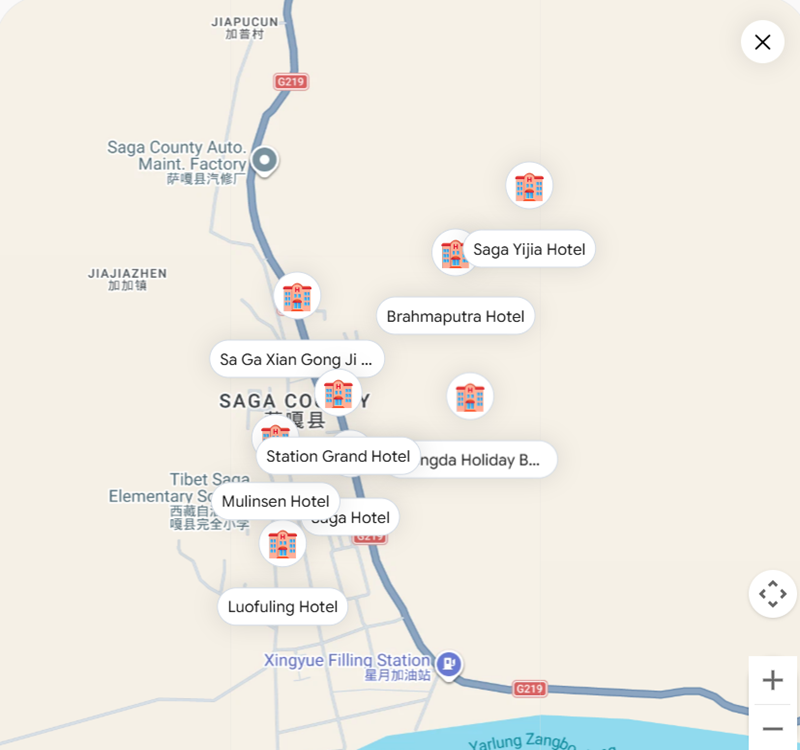
Accommodation Options in Saga County, Tibet (G219 Highway Corridor / Ngari Route Stopover)
Luxury and Premier High-End Hotels
Brahmaputra Hotel (Yalong Zangbu Hotel)
Quick Facts Field
Details
Location
Saga, Tibet; No. 42 Lunzhu Road, Saga County, Shigatse
Category
High-Altitude Deluxe Boutique Hotel
Estimated Nightly Cost
¥800 - 1,400+
Estimated USD Cost
US$110 - 200+
Rooms
Modern, spacious twin and double rooms with carpeted or heated flooring
Heating
24-hour underfloor central heating
Bathrooms
Private attached bathrooms with 24-hour continuous hot showers
Hot Water
Continuous 24/7 central hot water supply
Dining
On-site restaurant serving Tibetan and Sichuan cuisines
Suitability
Premier luxury choice for foreign tour groups, mountain trekkers, and pilgrims
The Brahmaputra Hotel (or the Yalong Zangbu Hotel, as it is commonly referred to there) is considered to be among the most luxurious high-altitude hotels in Saga Town. Being located at 4,600 meters above sea level, comfort and security are provided in the form of oxygen equipment in the rooms, coupled with a round-the-clock floor heating system. Modern room decorations, private bathrooms fitted with tiles, elevators and Wi-Fi are just some of the facilities available there. The hotel can be counted on for international tourists looking for high-end accommodation near the Kailash area.
Vienna 3 Best Hotel (Saga Branch)
Quick Facts Field
Details
Location
Saga, Tibet; Central Commercial District, Saga Town Center
Category
Mid-to-Upper Tier National Chain Hotel
Estimated Nightly Cost
¥700 - 1,200
Estimated USD Cost
US$100 - 170
Rooms
Modernized standard chain rooms with plush bedding and key-card access
Heating
Central radiator and floor heating systems
Bathrooms
Standard private bathrooms with enclosed shower units
Modern comfort seeking tour groups, business travelers, and self-drive tourists
Vienna 3 Best Hotel in Saga provides travelers with the comfort of home, standardized sanitation, and efficient property management. The building is purposely designed with temperature control, and the hotel uses an oxygen enhancement system in all its rooms to relieve visitors of acute mountain sickness symptoms. Visitors experience a modern look in the hotel with card-key access rooms, hot water all day long, Wi-Fi Internet connection, and a large courtyard parking facility. It's no wonder the hotel is rated among the best overland tours due to its hospitality, front desk, and central heating.
The Grand Hotel of Western Post
Quick Facts Field
Details
Location
Saga, Tibet; Central Highway G219 Corridor, Saga County
Category
Large Capacity Business & Transit Hotel
Estimated Nightly Cost
¥650 - 1,100
Estimated USD Cost
US$90 - 155
Rooms
71 Western-style guest rooms including double, twin, and suite layouts
Heating
Interior central heating radiators
Bathrooms
Spotless private bathrooms with hot shower stalls
Hot Water
24/7 dedicated hot water supply
Dining
Adjacent dining hall serving multi-course Chinese and Tibetan dishes
Suitability
Large overland tour groups, private vehicle convoys, and pilgrims
Grand Hotel of Western Post is an existing hotel facility on the major highway G219 in Saga. The hotel is equipped with 71 Western-style rooms, which can easily host large groups of travelers and caravans passing through western Tibet. The rooms have been furnished with hardwood furniture, clean bedding, toilets, and effective heating systems to counter cold nights. The hotel has a spacious parking space for tour buses and 4WD sport utility vehicles, as well as a restaurant that serves delicious food for travelers.
Lanjie Oxygen-Enriched Hotel
Quick Facts Field
Details
Location
Saga, Tibet; 169m North of Deji Rd & Gesang Rd Intersection
Category
High-Altitude Enriched-Oxygen Specialty Hotel
Estimated Nightly Cost
¥600 - 1,000
Estimated USD Cost
US$85 - 140
Rooms
Quiet soundproofed rooms with high-density mattress bedding
Heating
Integrated central room heating
Bathrooms
Private modern bathrooms with continuous hot water showers
Hot Water
24-hour instant hot water
Dining
On-site breakfast hall; close to town teahouses
Suitability
Travelers sensitive to altitude, overland couples, and premium tour groups
Designed specifically to cater to the physiological needs of sleeping at an altitude of 4,640 meters, Lanjie Oxygen-Enriched Hotel places great emphasis on indoor air quality and the availability of oxygen. Each of the rooms at the hotel has an oxygen-enriched diffusion system, enabling the guests to acclimatize themselves during the night comfortably. Apart from its oxygen facilities, the hotel has luxurious bedding, sound-proofed room walls, sheltered ground-floor parking and guaranteed hot shower services. This gives the travelers a conducive atmosphere in which to relax and recover physically after covering long distances by road in the high-altitude region.
Shengda Holiday Boutique Hotel
Quick Facts Field
Details
Location
Saga, Tibet; No. 035 Lunzhu Road, Saga County, Shigatse
Category
3-Star Deluxe Boutique Hotel
Estimated Nightly Cost
¥550 - 950
Estimated USD Cost
US$78 - 135
Rooms
Boutique-style standard, double, triple, and quadruple family rooms
Heating
Electric and central floor heating units
Bathrooms
Modern private attached tiled bathrooms
Hot Water
24-hour instant hot shower facilities
Dining
Nearby town dining facilities and local Tibetan eateries
Suitability
Families, small group travelers, and independent tourists seeking central lodging
Shengda Holiday Boutique Hotel is situated strategically along the main road named Lunzhu Road in the central part of Saga City. This hotel combines local Tibetan hospitality with the modern facilities of hotel lodging. Shengda Holiday Boutique Hotel has different types of rooms, including triple and quadruple rooms. This makes it perfect for group tourists like families or friends. The bedrooms are furnished with new contemporary furniture, soundproofing, a heater, and hot shower facilities at all times.
Mulinsen Hotel
Quick Facts Field
Details
Location
Saga, Tibet; Main Commercial Thoroughfare, Saga County
Category
High-Altitude Comfort Hotel
Estimated Nightly Cost
¥500 - 900
Estimated USD Cost
US$70 - 128
Rooms
Generously sized double and twin rooms with large windows
Heating
In-room floor heating systems
Bathrooms
Clean private bathrooms with modern plumbing fixtures
Hot Water
24-hour hot water supply
Dining
Nearby roadside restaurants and noodle houses
Suitability
Mid-budget travelers, overland drivers, and independent tours
The Mulinsen Hotel has gained a reputation as a mid- and upper-range establishment providing satisfactory comfort in terms of spaciousness and comfortable floor heating, in addition to large windows that create a bright and open environment for rest. Those travelers who need additional oxygen can make use of special equipment installed in their rooms. The private parking area and modern bathroom facilities make Mulinsen Hotel one of the best places to stay in Saga Town for the money you pay for your accommodation there.
Standard Hotels & Business Inns
Saga Yijia Hotel
Quick Facts Field
Details
Location
Saga, Tibet; Deji Road, Saga County, Shigatse
Category
Standard Business Hotel
Estimated Nightly Cost
¥350 - 600
Estimated USD Cost
US$50 - 85
Rooms
Functional standard twin and double guest rooms
Heating
Room electric wall heating units
Bathrooms
Private attached tile bathrooms
Hot Water
24-hour hot water showers
Dining
Surrounding local restaurants on Deji Road
Suitability
Self-driving travelers, budget tour groups, and individual drivers
Saga Yijia Hotel offers functional and practical lodging for those tourists who prefer to travel independently in their own vehicles. The rooms are nicely decorated and equipped with all necessary modern amenities, including carpeted floors, clean bed linen, and a heating system. Unlike typical low-budget hotels, Yijia Hotel offers its guests a private tiled bathroom with constant access to a 24-hour hot water shower. In addition, the hotel offers parking space and luggage storage service.
On-site dining hall and neighboring local restaurants
Suitability
Traditional tour groups, budget pilgrims, and overland transit stops
Given that it is one of the long-established tourist lodging services on Gesang Road, Saga Hotel has received guests from National Highway G219 for many years. It features basic guest accommodations in the form of Western-style rooms with electric blankets and under-floor heaters that can cope with the chilly nights on the plateaus. The facilities have an enclosed parking area for tour vehicles within the hotel compound. Being slightly outdated, it has a good historical position adjacent to local supplies and restaurants that makes the hotel popular amongst budget tour agencies.
Station Grand Hotel
Quick Facts Field
Details
Location
Saga, Tibet; Junction of Deji Road and National Highway G219
Category
Roadside Transit Hotel
Estimated Nightly Cost
¥300 - 500
Estimated USD Cost
US$42-70
Rooms
Simple double, twin, and triple standard rooms
Heating
Wall heating units and electric blankets
Bathrooms
Private attached bathrooms
Hot Water
Hot water available during evening hours
Dining
Local teahouses and eateries nearby
Suitability
Overland convoys, bus tours, and budget travelers needing parking
Located right on the junction of Deji Road and Highway G219, Station Grand Hotel plays the role of a mass transit hub where drivers enter or leave Saga Town. Its key feature lies in having a very spacious vehicle parking courtyard that readily suits even heavy buses, camper vans and 4x4 overland vehicles. Guest accommodations are quite basic and contain private baths, basic heating, and clean linen.
Luofuling Hotel
Quick Facts Field
Details
Location
Saga, Tibet; Sa Ga Xian Central Town Area, Shigatse
Category
Budget Standard Hotel
Estimated Nightly Cost
¥250-450
Estimated USD Cost
US$35-64
Rooms
Compact twin and triple budget guest rooms
Heating
Electric bed blankets and portable room heaters
Bathrooms
Private tiled shower rooms
Hot Water
Standard hot water showers
Dining
Proximity to surrounding town teahouses and food stalls
Suitability
Independent backpackers, budget travelers, and quick transit stops
The Luofuling Hotel has clean and affordable accommodation that is found just near the central marketplace of Saga. The hotel has twin and triple budget rooms with electric blankets and heaters to keep off the cold at night. Portable oxygen bottles can be arranged at the front desk on request. Given the hotel’s private showers, courtyard parking, and cheap accommodation, it is a budget-friendly place for trekkers to stay overnight without breaking the bank.
Sa Ga Xian Gong Ji Hotel
Quick Facts Field
Details
Location
Saga, Tibet; 400m North of People's Court along G219 Highway
Category
Economy Standard Inn
Estimated Nightly Cost
¥220-400
Estimated USD Cost
US$31-56
Rooms
Simple twin and double economy rooms
Heating
Standard electric bed blankets
Bathrooms
Private attached shower rooms
Hot Water
Hot water showers available daily
Dining
Roadside noodle shops and local restaurants nearby
Suitability
Local transport drivers, overland truckers, and budget travelers
Sa Ga Xian Gong Ji is a humble roadside hotel that can be accessed about 400 meters from the People's Court of Saga on National Highway G219. It mostly hosts local motorists and economical travelers by providing them with small yet affordable rooms with electric blankets and modest bathrooms. It is strategically placed along the highway such that motorists can easily access food and repair services for their cars.
Saga Post Hotel
Quick Facts Field
Details
Location
Saga, Tibet; Post Office Road / G219 Intersection
Category
Municipal Standard Inn
Estimated Nightly Cost
¥200-380
Estimated USD Cost
US$28-54
Rooms
Budget double and triple rooms
Heating
Electric blankets and space heaters
Bathrooms
Combination of private and shared bathroom arrangements
Hot Water
Continuous hot drinking water dispensers; hot showers
Dining
Central location near town food stalls and teahouses
Suitability
Low-budget backpackers and independent travelers
Saga Post Hotel is an ordinary hotel run by the government that lies just next to the major intersection of post offices in Saga. This hotel is widely preferred by travelers who travel solo since it is cheap and offers genuine local flavor. The rooms available at this hotel are double and triple, with good quilts and electric heaters in the rooms. Bathrooms can either be private or in the corridor. The hotel is situated in the heart of the city where it is possible to reach banks, post offices, and tea shops.
Additional Luxury Hotels Dream Tibet Travel Provides Traveller Accommodation in
Hotel Qiangjib
Hotel Qiangjib is a central hotel in Saga, Tibet, providing heated twin and double rooms along with bathrooms equipped in the Western style. The rooms have comfortable bedding, charging points, and shower facilities along with basic toiletries. The hotel provides its dining hall with Tibetan and Chinese style food, also serving vegetarian dishes on prior request. Its proximity to the shopping areas of Saga makes it suitable for Kailash Mansarovar pilgrims spending the night before moving towards the sacred lake.
Quick Facts
Details
Location
Central Saga town
Category
Luxury/upgraded local hotel
Star rating
Official classification unverified
Estimated double-room cost
US$90-120/night
Estimated twin-room cost
US$85-115/night
Bathrooms
Attached Western-style facilities
Heating
In-room heating
Dining
Tibetan and Chinese-style meals
Other services
Laundry, Wi-Fi and first-aid facilities reported
Western Station Hotel
The Western Station Hotel is a place where heated double- and twin-bedded rooms are available close to the main transport hub of Saga. The rooms have warm bed covers and private bathrooms that include Western-type bathrooms and hot showers, along with charging points. The common dining hall of the hotel is equipped to provide meals in Tibetan, Chinese and Nepali cuisine styles.
Quick Facts
Details
Location
Central Saga transport area
Category
Luxury/upgraded local hotel
Star rating
Official classification unverified
Estimated double-room cost
US$95 - 130/night
Estimated twin-room cost
US$90 - 125/night
Bathrooms
Private Western-style facilities
Heating
Heated rooms
Dining
Tibetan, Chinese and Nepali-style meals
Other services
Laundry, Wi-Fi and oxygen equipment reported
Saga Tibet Shopping
Saga Tibet is a good destination for stocking up before moving ahead to Lake Mansarovar and Mount Kailash. There are small grocery stores and shops available that supply daily necessities; however, they do not offer wide-ranging goods compared to Kathmandu, Kerung and Lhasa. Pilgrims usually visit shops only when they check into their hotels at Saga, provided they feel well enough due to the high altitude.
Grocery Shops: Food, Snacks and Drinking Water
Pilgrims can find the following goods in the local shops at Saga:
Drinking water: Bottled drinking water and packaged drinks.
Snacks: Biscuits, chocolates, crackers, and noodles.
Travel food: Nuts, dried fruits, packaged bread, and other snacks.
Fruit: Apples, oranges, or bananas depending on availability.
Hot beverages: Tea and instant coffee, wherever available.
Vegetarian travelers must check the labels of packaged foods, particularly those containing meat in instant noodles and soups.
Toiletries, Clothing and Travel Essentials
The general stores of Saga may stock:
Toothpaste, toothbrushes, soaps, and shampoos.
Tissues, toilet paper, wet wipes and sanitary supplies.
Basic socks, gloves and woolen caps.
Batteries, chargers and phone accessories.
Sun cream and lip balm if available.
Do not rely on Saga to provide properly fitted hiking shoes, special raincoats and prescription medications. These must be bought before leaving Kathmandu or Lhasa.
Local Markets and Tibetan Souvenirs
Certain stores might sell prayer flags, incense, rosaries and small religious relics. The variety will be far less than what is found in Lhasa's famous handicrafts markets.
Travelers buying religious goods must not take it for granted that these are locally manufactured or consecrated.
Shopping Payments and Preparation Before Departure
Keep smaller denominations of Chinese yuan (RMB). Mobile payments might be accepted, but there are no guarantees about foreign cards and international payment applications.
Before you leave Saga, prepare your drinking water, snacks, and other items that you will need during your trip. There will be fewer places where you can buy things along the road to Mansarovar, and prices might be higher.
Ask your guide what shops are available near your hotel instead of going around town without any reason at 4,500 meters.
Saga Tibet Time, Daily Schedule and Preparation Before Leaving for Lake Mansarovar
Saga is usually an overnight stop before the long drive to Lake Mansarovar. According to the schedule of Dream Tibet 16-day Full Moon Kailash Yatra, the group arrives at Saga on Day 8 and then leaves for Mansarovar on Day 9. It is necessary to cover 400 km in 9 hours, so it is better to consider hotel check-out, breakfast, luggage and health problems.
Saga Tibet Local Time and Time Difference from Nepal
The Saga region is in China Standard Time (UTC+8), which is 2 hours and 15 minutes ahead of Nepal Standard Time (UTC+5:45). The whole country of China observes the same time zone.
Location
Time when it is 6:00 AM in Nepal
Kathmandu
6:00 AM
Kerung, Tibet
8:15 AM
Saga, Tibet
8:15 AM
Lake Mansarovar
8:15 AM
Lhasa
8:15 AM
The pilgrims crossing into China from Nepal should set their phones and watches to the official time in China. Hotel breakfast times, vehicle departure times, and briefing times should all be based on the time of the Tibet side operator, and not Nepalese time.
Hotel Arrival, Check-In and Evening Arrangements in Saga
Groups traveling from Kerung or Shigatse usually arrive in Saga in the afternoon or evening, depending on the road conditions.
After arrival, pilgrims should obtain their room keys, check that heating and bathroom facilities are working, and arrange for the following day's activities. Pilgrims who require help with luggage should ask for it instead of going up and down stairs at an altitude of approximately 4,500 meters.
Before dinner, arrange for breakfast, departure plans, and any special dietary needs. Use the evening to recharge your devices, organize your clothing and get some rest.
Breakfast, Luggage Loading and Morning Departure
Morning activity
What pilgrims should check
Before breakfast
Assess headache, nausea, breathing and sleep quality
Breakfast
Eat adequately; confirm vegetarian arrangements
Room checkout
Check drawers, bathrooms, chargers and documents
Luggage loading
Confirm the main bag is loaded into the correct vehicle
Day-bag preparation
Keep essentials accessible during the drive
Departure briefing
Confirm stops, expected driving time and lake accommodation
Do not keep the passport, prescription drugs, drinking water, and warm clothing in luggage that cannot be accessed.
Clothing, Snacks and Drinking Water for the Saga–Mansarovar Drive
It passes through a plateau environment wherein shops, toilets, and places to get food may not be readily available during the drive.
These items need to be within easy reach:
Insulated jacket, fleece, gloves, and windproof clothing.
Drinking water and individually packaged snack foods.
Prescribed medicine, tissues, and hygienic essentials.
Sunglasses, sunscreen, and lip balm.
Complete phone, power bank and charging cable.
Passport and other travel documentation.
Bag for your rubbish.
Pilgrims should not have to rely on buying their necessities from roadside shops after leaving Saga.
Guide Briefing and Health Checks Before Continuing
Prior to departure, it is the responsibility of the guide to know if any pilgrim has had headaches, nausea, vomiting, unusual weakness, or breathing problems during the night.
The height at Saga is quite high, and traveling to Mansarovar does not reduce the chances of altitude sickness. Any individual experiencing any symptoms needs to make that known before getting into the vehicle. The pulse oxygen reading is just an indication and does not guarantee that one is fit to move on.
The briefing also needs to address the nature of the roads, lunch places, time of arrival, accommodation, and any other lake-side activity restrictions.
For those going to Lake Mansarovar for religious purposes, making adequate preparations in Saga will help avoid complications during the next stage. It is not advisable to complete the journey before undertaking any necessary health evaluation
What Food Is Saga Tibet Famous For?
Saga Tibet is famous for its food from the Tibetan plateau and is particularly known for tsampa, thukpa, momos, and butter tea. Pilgrims who are on their way to Mount Kailash and Lake Mansarovar can find both Tibetan and Chinese food in restaurants or hotels. The availability of food depends on the restaurants and season.
Vegetarian Food in Saga Tibet
Vegetable Momos: Steamed dumplings filled with cabbage, potato or seasonal vegetables.
Vegetable Thukpa: Hot Noodle Soup made of Vegetables and Vegetable Broth.
Tsampa: A powder made from barley flour, mixed with buttermilk or water.
Tingmo: Fluffy steamed Tibetan bread served with soup or vegetables.
Vegetable Fried Rice: Rice made with vegetables obtained in the local area.
Butter Tea: Salted butter tea.
Non-Vegetarian Food in Saga Tibet
Yak Meat Momos: Dumplings which are made with minced yak meat.
Yak Thukpa: A noodle soup made with yak meat and broth.
Shapta: This is a type and style of Tibetan stir-fried meat along with some vegetables.
Sha Balep: Fried Tibetan bread stuffed with meat that has been well seasoned.
Yak Meat stew: This is meat cooked slowly with either potatoes or vegetables.
Veg pilgrims should check the soups that they are consuming to be sure that there is no meat broth.